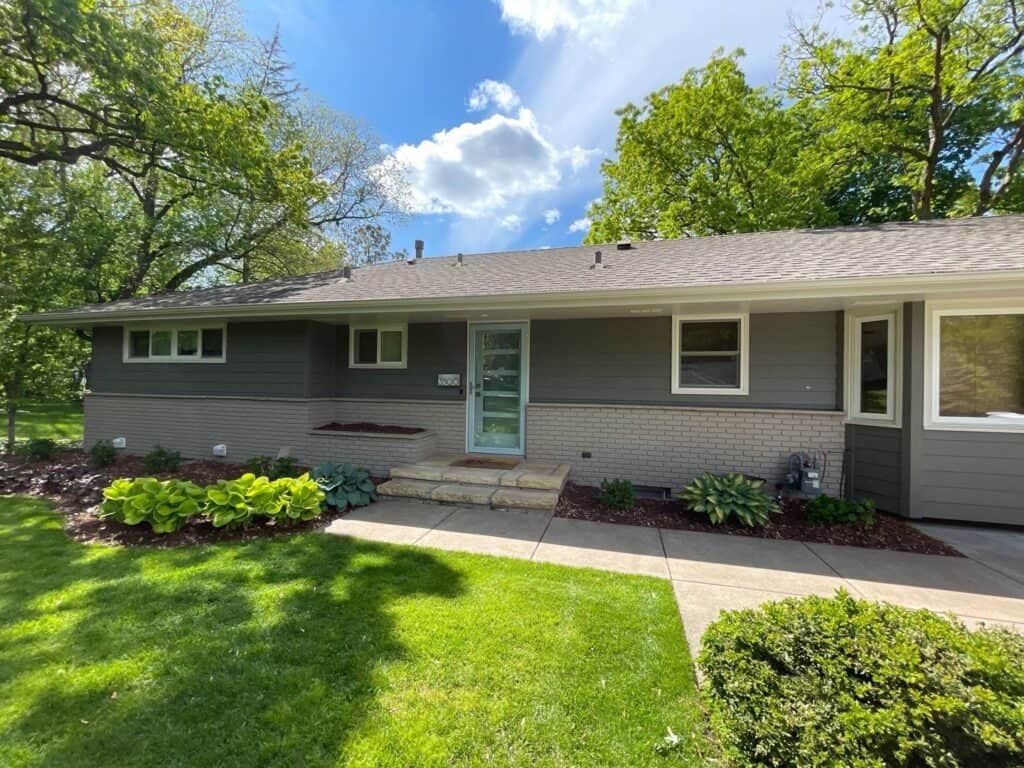
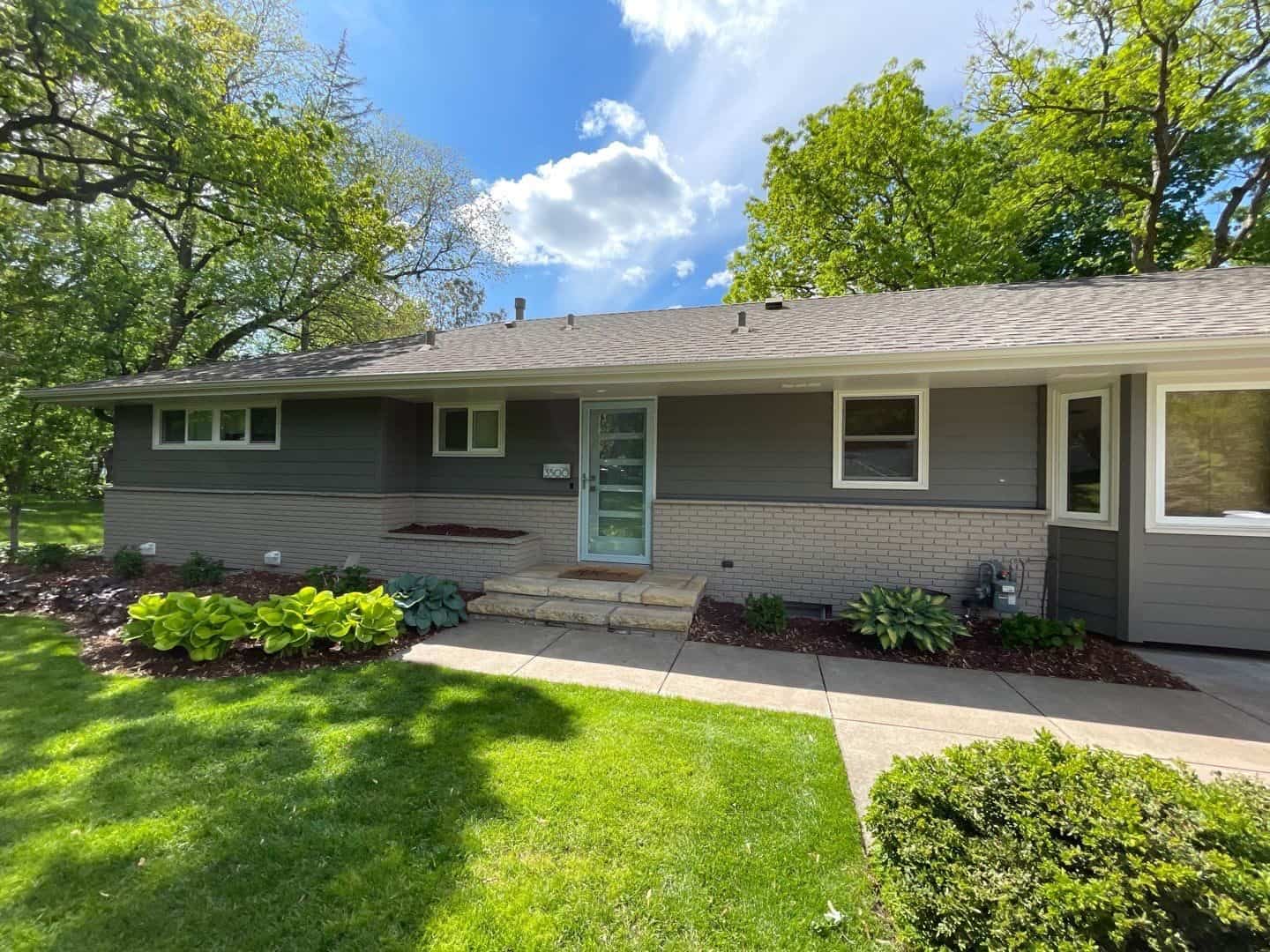
Vinyl, LP SmartSide engineered wood, James Hardie fiber cement and steel: all four materials we install can be the right call for a Minnesota house, and each brings different tradeoffs to a winter. The best siding for your house depends on which of those tradeoffs matters most for your walls and your lot.
This guide compares the four on what a Twin Cities winter actually does to an exterior: freeze-thaw cycles, deep-cold impacts, hail, wind-driven snow and the upkeep each material asks of you. No prices here; our siding replacement cost guide covers what moves the number. This one is about performance.
The short version: vinyl is the low-upkeep, budget-friendly panel whose weak spot is impact in severe cold. LP SmartSide is the engineered-wood option with no damage from 1.75-inch hail in its own sponsored lab tests. James Hardie fiber cement is the dimensionally stable, noncombustible option engineered for freezing climates. Steel is the option whose panel absorbs no water, though the wall behind it still needs the same water-resistive barrier and flashing as any siding; its tradeoff is denting. Each section below gives one material its winter tests, and the comparison table puts them side by side.
What a Minnesota winter does to siding
Winter attacks siding four ways:
- Freeze-thaw. Water expands nearly 10% when it freezes. Moisture trapped in or behind a panel can contribute to deterioration over repeated freeze-thaw cycles, which is why drainage, clearances and flashing details matter as much as the panel itself.
- Deep cold. Some materials stiffen and turn brittle as temperatures drop, which changes how they react when something hits them: a ladder, a branch, a shovel of roof snow.
- Hail. The storms arrive in spring and summer, but the damage pattern is built into the material. Whether your siding cracks or dents decides what a storm does to your wall, so hail belongs in a winter comparison.
- Moisture and wind. Wind-driven snow piles against walls, melts on warm afternoons and refreezes overnight. Siding is the first layer of defense, and how the wall behind it is wrapped matters as much as the panel itself.
Keep those four tests in mind. Each material below handles them differently.
Vinyl siding in a Minnesota winter
Vinyl’s case is cost and upkeep: the color is part of the panel, it never needs paint, it does not rust or rot, and routine care is a rinse with a hose. It is a familiar material here: in 2025 Census data, vinyl was the principal exterior wall material on 47% of new single-family homes started in the West North Central division, which includes Minnesota. Its winter strength is moisture. The panels absorb no water, so freeze-thaw cycles have nothing to grab onto in the material itself.
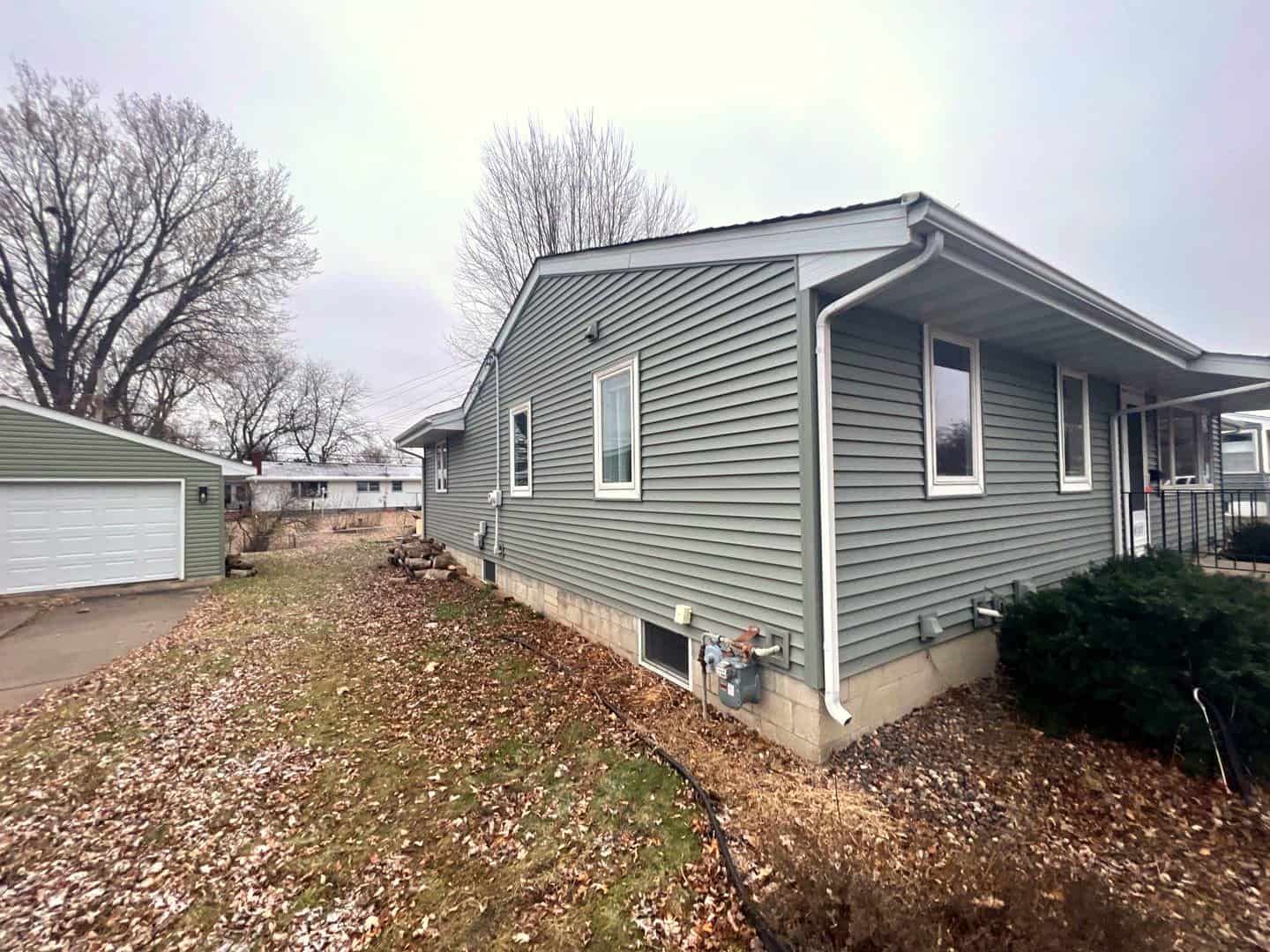
Its winter weakness is impact in severe cold. Vinyl gets more brittle as temperatures drop, and home inspector guidance from InterNACHI notes that in severe cold vinyl can crack when something hits it. That is also why vinyl’s fastening is so specific: nails centered in the slots with the clearance the manufacturer specifies, so the panels stay locked but free to move, with expansion room at the trim. The exact clearances come from the product’s installation instructions. In ice-ball impact testing by Haag Engineering, vinyl panels fractured at simulated hail roughly three-quarters of an inch to an inch and a quarter across, usually at the laps between panels.
The upgrade to know is insulated vinyl, which bonds a foam backing to the panel. It is its own product category (ASTM D7793 is its standard) and adds a modest R-value at the wall. If you like vinyl’s upkeep but want a bit more insulation at the wall, that is the version to price.
LP SmartSide in a Minnesota winter
LP SmartSide is engineered wood: wood strands bonded with industrial-grade resins, waxes and zinc borate, a recipe LP calls SmartGuard, which LP credits with resistance to fungal decay and termites that raw wood does not have. It looks like wood because it mostly is, and it takes paint like wood. LP makes SmartSide siding in northern Minnesota, at its Two Harbors plant.
Its winter story is impact resistance. In LP’s own testing at the National Wind Institute’s debris impact facility at Texas Tech, SmartSide lap siding showed no damage from 1.75-inch hail at 81 mph, while comparable fiber cement dented and vinyl fractured at smaller, slower impacts in the same tests. LP also notes its lap siding is up to 39% lighter per square foot than fiber cement, which makes handling and staging easier.
The tradeoffs: it is a wood product, so it is combustible like wood, and whether it is primed and painted on site or ordered in LP’s factory-finished ExpertFinish line, the finish will want repainting or recoating on a cycle over its life. Water management at cuts and joints is what keeps it healthy, so installation details matter as much as the panel.
James Hardie fiber cement in a Minnesota winter
James Hardie’s answer to winter is literal engineering for it. Hardie makes different formulations for different climates (the Hardie Zone system), and the HZ5 line sold in our region is Hardie’s formulation for freezing temperatures, wide seasonal temperature swings, and snow and ice, with a surface engineered for moisture resistance and paint adhesion and a drip edge for better water management.
Fiber cement is noncombustible: Hardie’s own rating is that it will not burn or ignite under direct flame. It is also dimensionally stable, so it does not move with temperature the way vinyl does. The factory ColorPlus finish is baked on in a controlled process rather than painted on site.
The tradeoff is rigidity. Like any cement product, fiber cement can chip at edges or crack under a sharp hit. In LP’s hail testing, the comparable fiber cement panels showed dents where SmartSide showed none. The installation details are specific to the product and finish. For HardiePlank HZ5 lap siding, Hardie’s own instructions call for a water-resistive barrier with penetration and junction flashing behind the panels, butt joints detailed over joint flashing rather than caulked, and clearances that keep the boards off roofs, decks and grade. Cut-edge treatment depends on the finish: primed boards and ColorPlus boards follow different instructions. Those details belong in the written scope.
Steel siding in a Minnesota winter
Steel’s winter case starts with moisture: the panel itself absorbs no water, so it will not swell, rot or support mold, and cold does not make the panel brittle the way it can vinyl. The finish is the part that needs care: scratches or cut edges that reach bare metal can corrode, so keeping the coating intact is what keeps the panel healthy.

One local name in steel: EDCO, a steel siding maker headquartered in Hopkins. Whatever the line on your quote, the finish and the warranty belong to that specific product, and your estimate should name both.
The tradeoff is denting. In Haag Engineering’s ice-ball testing, 29-gauge steel panels dented at about a 1-inch simulated hailstone, but no steel panel fractured or punctured at any size tested. Dents can be cosmetic, but after a real storm the check is broader than the panels: the coating at each dent, the seams and attachments, and whether anything bent enough to change how the wall sheds water. Small dents are hard to spot; the Haag study needed raking light and fingertips to find them. Day to day, care follows the finish on the specific product: an occasional rinse, and attention to any scratched or dented spots per the manufacturer’s guidance.
How the four compare on a Minnesota winter
| Material | Handles well | Watch for |
|---|---|---|
| Vinyl | Moisture and upkeep: absorbs no water, never needs paint | Gets brittle in severe cold; hail can crack panel laps |
| LP SmartSide | Impact: no damage from 1.75-inch lab hail in LP’s own tests | A wood product: painted finish needs upkeep cycles, combustible like wood |
| James Hardie | Freeze-thaw: HZ5 line engineered for freezing, wet climates | Rigid panel; can chip under a sharp hit |
| Steel | Moisture: absorbs no water, will not swell or rot | Hail can dent panels; finish damage can corrode if ignored |
No column wins every row, which is the point. Match the material to your house:
- Exposed lot in hail country: weigh impact performance, and remember the crack-versus-dent difference.
- Shaded lot that stays wet: weigh moisture behavior, and the finish care each material needs.
- Busy household that wants the least upkeep: weigh the finish, because that is what sets the maintenance schedule.
- Character home where looks lead: weigh the wood look of LP SmartSide or the painted finish of fiber cement against vinyl and steel profiles.
Hail: what actually happens when it hits
A useful public dataset comes from Haag Engineering, a building-damage research firm with a Twin Cities office in Burnsville, which fires freezer ice balls at siding test panels in the lab to find each material’s damage threshold. Their findings: vinyl fractures (their test panels broke at ice balls roughly three-quarters of an inch to an inch and a quarter across, usually at the panel laps), while metal dents instead of breaking (29-gauge steel’s dent threshold was about a 1-inch ice ball, and no metal panel fractured at any size tested).
LP commissioned its own testing at Texas Tech, firing simulated hail at SmartSide and comparable fiber cement and vinyl panels. SmartSide showed no visible damage at 1.75-inch hail at 81 mph, the fiber cement dented, and the vinyl fractured at 1.25-inch hail at 57 mph. LP sponsored that test, so it is one data point next to the independent Haag results. The practical question is whether your material cracks or dents, because that shapes what a storm does to your wall. These are lab thresholds for specific test panels, not promises about what any real storm will do.
If hail has already hit your siding, our hail damage guide walks through what to check before you call your insurer.
Does new siding make your house warmer?
Not by itself. Siding is cladding; the insulation in your walls and attic does the thermal work. Inspector guidance is blunt on this point for vinyl in particular: the panel itself is not insulation, and plain vinyl adds essentially nothing to your wall’s R-value.
Two things can still help. Insulated vinyl bonds a foam backing to the panel and carries a tested R-value for the panel itself. That is different from stopping drafts: air control and water drainage are distinct functions at the sheathing, and a water-resistive barrier does not automatically provide continuous air sealing, so air sealing is its own detailing step. A residing project is a natural opportunity for it because the walls are open. And if the walls are under-insulated, residing is a rare practical chance to add continuous rigid insulation over the sheathing, which cuts the heat loss through the studs themselves. If winter comfort is the goal, say so at estimate time, because it changes what is worth doing while the old siding is off.
Mixing materials: the Minnesota Mullet
Not every house needs one material everywhere. Some of our projects put a premium material on the street-facing elevations and a budget-friendly one on the sides and back, an approach we wrote about in The Minnesota Mullet. Where two materials meet, the transition trim and flashing decide how the wall handles water, so the mixing plan belongs in the written scope.
What a good siding estimate includes
A residing quote is a scope document, like a window quote. Look for:
- The material and the specific product line, named (not just “vinyl” or “fiber cement”)
- Panel profile, thickness or gauge, and color
- For vinyl: standard or insulated, and the foam backing spec if insulated
- For steel: the gauge, and the finish warranty terms
- Housewrap, and any air sealing while the walls are open
- Flashing details: above windows and doors, and kickout flashing where a roof edge meets a wall
- Trim, soffit and fascia scope: replaced, wrapped or left alone
- How corners, channels and penetrations (lights, outlets, vents) are handled
- Tear-off and disposal of the old siding
- How hidden sheathing damage is priced and approved
- Product warranty and workmanship warranty as separate items
First Impressions Exteriors offers a 10-year workmanship warranty. Ask for both warranties in writing; they have different terms and different lifespans.
Recent siding projects
We install all four materials across the west metro, and our recent project posts have leaned heavily on LP SmartSide. A few examples: LP SmartSide work in Plymouth, a Snowscape White LP SmartSide project in Golden Valley, a dark exterior with white trim in Maple Grove, and a Tundra Gray residing in Hopkins. Each page walks through the material choice and the finished home.
Signs your current siding is telling you something
None of these means a residing tomorrow, but each is worth a look:
- Soft or spongy spots when you press the wall: that can mean moisture has gotten into the wall, and it is worth having checked.
- Paint that peels or bubbles again within a few years of repainting: it can come from the paint job, the surface prep or moisture moving through the wall, so it is worth finding out which.
- Panels that warp, gap at the seams or pull away from the corners.
- Cracked vinyl or chipped boards that can let water behind the panel.
- Staining on interior walls near the exterior: it can come from the siding, the flashing, a window or the roof, and an inspection is how you find the source.
Any of these is a reason for an inspection, and a residing estimate should say what happens if the crew finds damage behind the old siding.
Siding and Minnesota winter FAQs
What is the best siding for a Minnesota winter?
There is no single winner; the right answer depends on the house. All four materials we install handle Minnesota winters when they are installed to spec. Each leads somewhere different: vinyl on upkeep and moisture, LP SmartSide on tested impact resistance, James Hardie on its engineered-for-cold HZ5 formulation and stability, and steel on moisture and crack resistance. The best choice is the one whose strengths match your lot, your hail exposure and how much maintenance you want to do.
Does vinyl siding crack in cold weather?
It can. Vinyl gets stiffer and more brittle as temperatures fall, and in severe cold it can crack when something hits it: a ladder, hail, a snow shovel. Quality panels and correct fastening, nails centered in the slots with the manufacturer’s specified clearance so the panels can move, reduce the risk. Day to day, cold alone is not the problem for vinyl; the risk is impacts in deep cold, not the temperature itself.
Is fiber cement or engineered wood better for freeze-thaw?
Both handle freeze-thaw well when installed to their specs. James Hardie’s HZ5 formulation is engineered specifically for freezing, wet climates, and LP SmartSide’s treated strands, resins and waxes resist the decay that moisture causes. Whatever the panel, flashing, clearances, and manufacturer-specified cut-edge treatment and joint details keep water where it belongs through freeze-thaw season, so those details belong in the written scope.
Does steel siding dent in hail?
Yes, and that is the trade to understand. In Haag Engineering’s ice-ball testing, 29-gauge steel panels dented at about a 1-inch simulated hailstone, but no steel panel fractured or punctured at any size tested. Dents can be cosmetic and hard to see, but a storm inspection should check the coating at each dent, plus the seams and attachments, because a hit that cracks the finish can expose metal to corrosion. Finish and hail coverage terms belong to the specific steel line on your quote, and your estimate should name them.
Will new siding lower my heating bills?
Not by itself. Siding is cladding, not insulation; your wall and attic insulation do the thermal work. Insulated vinyl carries a tested R-value for the panel itself, and a residing project is a natural chance to add a continuous air barrier with sealed transitions while the walls are open, which is separate work from the panels themselves. If lower bills are the goal, the estimate should say exactly what happens behind the new panels.
Can siding be installed during a Minnesota winter?
Sometimes, when the day’s weather and the materials’ handling limits allow it. Sealants and caulks carry manufacturer temperature minimums, finishes need dry surfaces, and vinyl gets more brittle to handle in deep cold. Days with precipitation or extreme cold get rescheduled rather than forcing materials past their limits, and your contractor should be able to tell you the temperature rules for the specific product going on your house.
Which siding needs the least maintenance?
All four need periodic washing and a yearly look at caulked joints and flashing. After that, the finish sets the workload. Vinyl’s color is integral to the panel, so there is no paint to maintain. Steel’s care depends on the finish on the specific line: follow the manufacturer’s guidance, and treat scratches or dents that reach bare metal before corrosion starts. James Hardie’s ColorPlus boards carry a factory-baked finish with its own warranty term, while field-painted boards follow normal repaint cycles. LP SmartSide comes primed for painting on site or in LP’s factory-finished ExpertFinish line, and either finish eventually wants recoating like other painted exteriors. Your quote should name the product line and finish, because that is what sets the maintenance schedule.
What warranty should a new siding quote include?
Two separate warranties. The manufacturer covers the product, and terms differ by brand and product line: some are prorated, some are not, and finish coverage is often separate from panel coverage. The installer covers workmanship; First Impressions Exteriors offers a 10-year workmanship warranty. Your estimate should name the quoted product line and both warranties in writing, because they have different terms and different lifespans.
How do I know when siding needs to be replaced?
One or two damaged panels do not settle the question on their own. If the damage is contained and the profile is still available, a repair may be enough, but damage behind the panels or a discontinued profile can change that. Patterns are what push a house toward replacement: soft or spongy spots in the wall, paint that peels again within a few years of repainting, panels that warp or gap at the seams, or repeated cracking. An inspection tells you which situation you are in, and a residing estimate should say what happens if the crew finds damage behind the old siding.
What siding does First Impressions Exteriors install?
All four materials in this guide: vinyl, LP SmartSide engineered wood, James Hardie fiber cement and steel. The right pick depends on your house’s exposures, your maintenance appetite and your budget, and a written estimate should name the specific product line so you can compare it against this guide.
Get a straight answer for your house
The four-way comparison above is the starting point: the best siding is the one matched to your lot, your exposures and how you want to live with it. That takes a look at your actual walls, not a web page.
First Impressions Exteriors is based in Golden Valley and has served Minnesota and Wisconsin since 2008. We install vinyl, LP SmartSide, James Hardie and steel siding, along with roofing, windows, gutters and storm restoration. Minnesota contractor license: BC631617.
Call 763-762-8934 or schedule a free estimate. We will walk the house with you and put the options in writing.