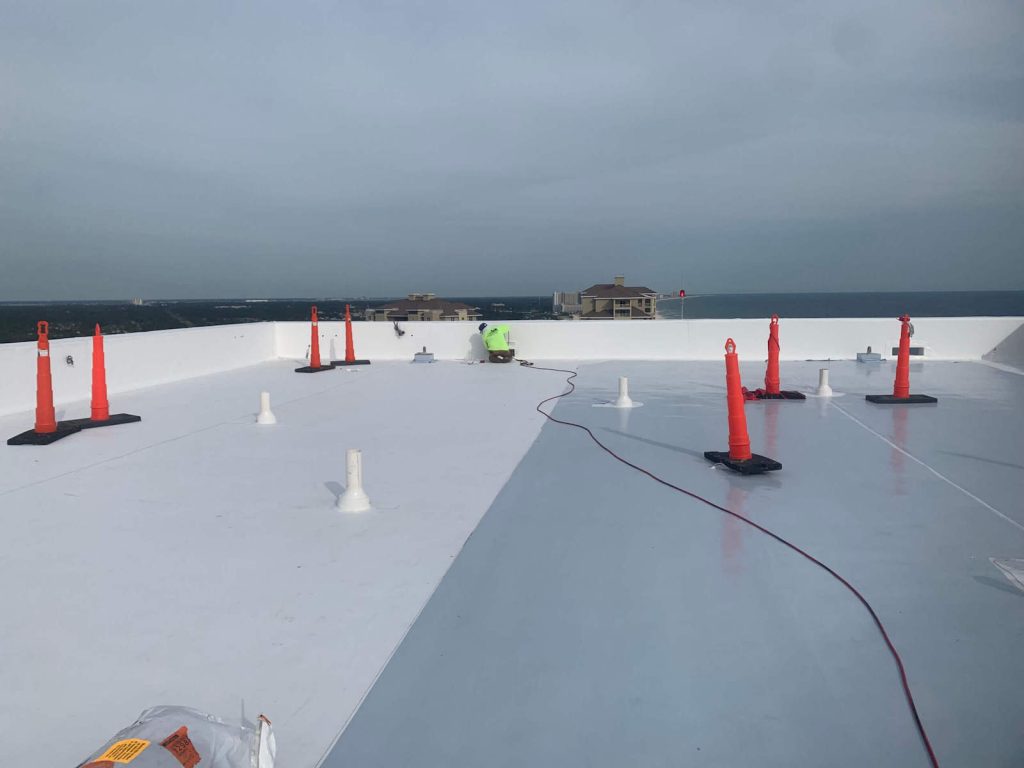
PVC roofing earns its place on buildings where the roof has a harder job than keeping out rain: restaurants and food plants that vent grease, and facilities with chemical exhaust. If your building has a white single-ply membrane and you are not sure whether it is PVC or TPO, do not guess from color, because the two look alike from the ground and they age differently. The installation paperwork will say which one you own. If the records are gone, a qualified roofing professional can verify the membrane type on site.
Two facts shape how a PVC roof should be inspected and maintained. Its seams are fused with hot air, and the condition of those welds is central to whether the roof performs as one continuous skin. And the membrane’s chemistry can change as it ages, which changes what repairs are practical late in its life. This post covers what a thorough PVC inspection looks for, how often to schedule one in Minnesota, and the maintenance that protects both.
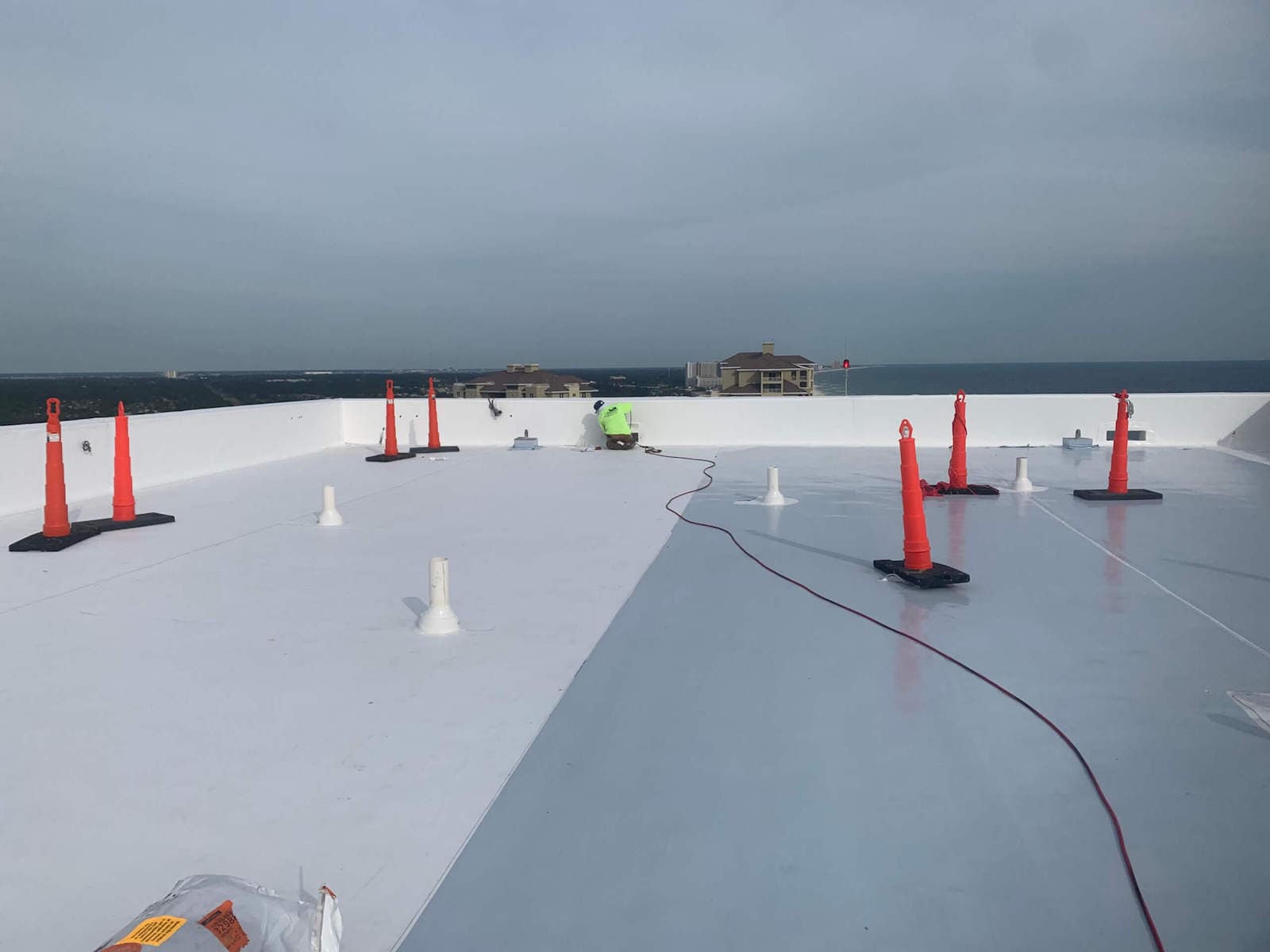
The framework below is what a qualified PVC roof inspection should cover, whether the roof is two years old or twenty. If parts of your building carry TPO instead, our guide to TPO roof inspections and maintenance covers that system.
Seams: inspecting the welds
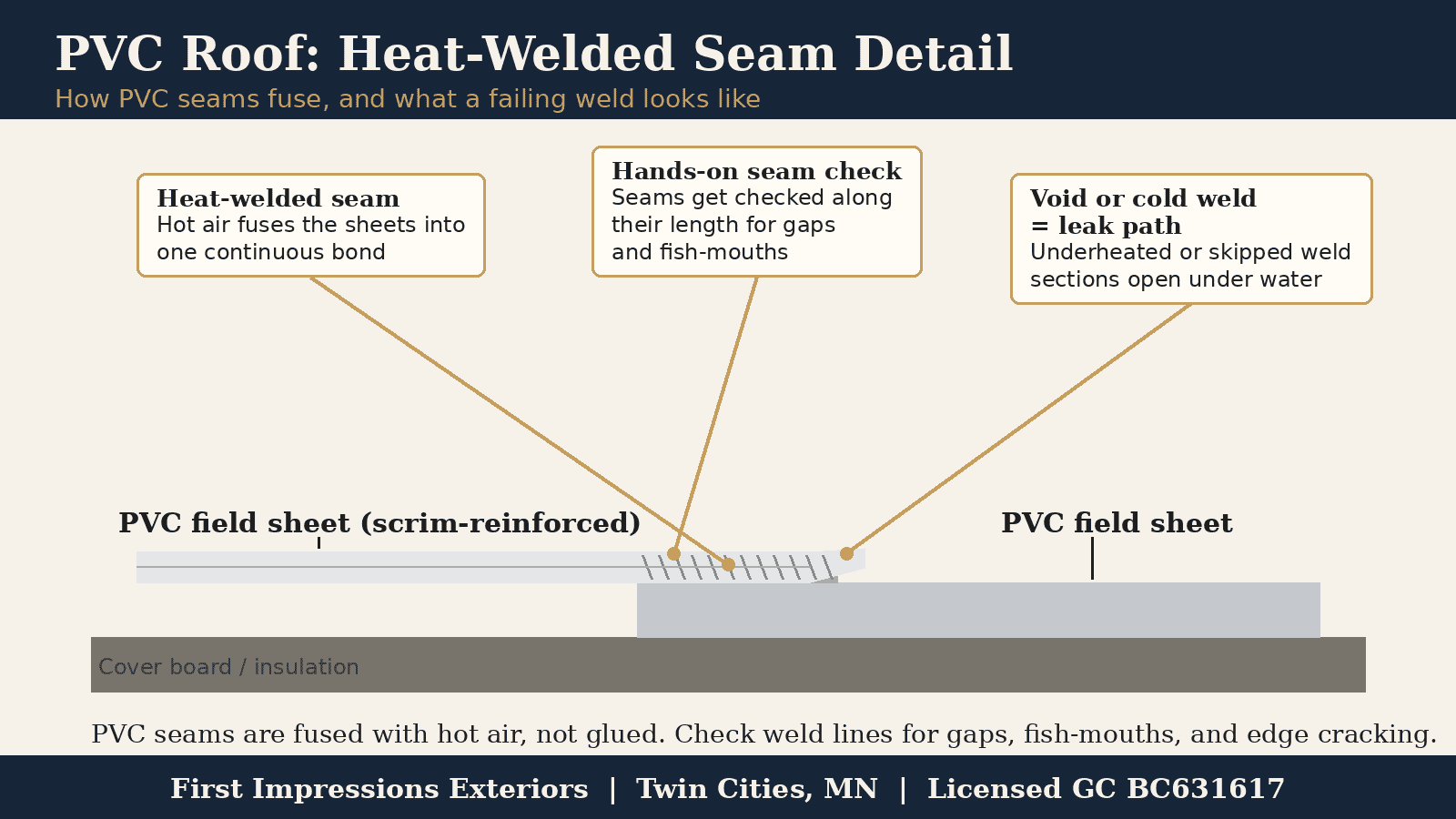
PVC seams are heat-welded: hot air fuses the overlapping sheets into a single continuous bond. Done right, a welded seam is as strong as the membrane itself. But a weld is made on a specific day, at a specific temperature, by a specific operator, and welds can hide voids, cold spots, and skipped sections that look fine from standing height.
That is why seam inspection on PVC is a hands-on task, not a glance. An inspector checks seams along their length for gaps, fish-mouths at the overlaps, and areas where the weld never fully bonded. On older roofs the material next to the weld matters as much as the weld itself: a membrane that has gone brittle can crack right at the seam edge even when the weld is intact. The same principle applies to repairs. On healthy membrane a patch welds reliably; on brittle membrane it may not take, which is why repairability on an aging PVC roof is evaluated with a test weld on the actual roof, weighed together with the membrane’s overall condition.
How the membrane changes with age
Mule-Hide’s Standard PVC line, for example, is a scrim-reinforced membrane offered in 50, 60, and 80 mil thicknesses, so the field sheet has a reinforcing scrim under the surface. What inspectors watch instead is flexibility. PVC stays pliable because of plasticizers in the compound. Over time those plasticizers can migrate out of the sheet, and where that happens, the membrane stiffens and can turn brittle.
Where that aging is underway, the signs show as fine surface cracking or crazing, usually on the runs that get the most sun. From there the question is how far it has gone, and the answer matters for two reasons. A brittle membrane cracks under stress, including foot traffic in cold weather, so an old PVC roof in January is not a place for casual walking. And brittleness can set a repair ceiling, because a sheet that has lost flexibility may not take a reliable weld, which is why repairability gets tested on the actual roof rather than assumed. An experienced inspector checks flexibility cautiously, precisely because bending aged membrane too hard can damage it.
Grease zones and chemical exposure
One application where PVC earns its premium is buildings with kitchen exhaust. Animal fat and grease degrade many other single-ply membranes, while PVC resists them, which is why manufacturers market it for food service and food processing buildings.
Chemical compatibility cuts both ways, though. Asphalt-based products and some solvents damage PVC, so repairs, coatings, and even material tracked onto the roof from other work need to be compatible. Grease resistance is also not a pass to ignore the roof around exhaust fans. Grease still accumulates, hides punctures, and makes the surface slick and unsafe to walk. Inspectors check the containment systems around exhaust equipment and the membrane beneath them more often than the rest of the roof.
Details and drainage
Pipes, curbs, drains, skylights, and wall transitions are finished with PVC flashing membrane welded to the field sheet, or with PVC-clad metal edge details. These areas carry the most movement on the roof, and on an aging system they are where shrinkage shows first: membrane pulling tight at corners, bridging above the substrate, or stress on the welded attachments around a curb. Sealant at metal terminations shrinks and cracks with age. A leak investigation on a PVC roof starts at these details.
Drainage gets the same attention as on any low-slope roof. Strainers, drains, and scuppers need to run clear. Water that remains more than 48 hours after precipitation meets the NRCA definition of ponding. Ponding is not a leak diagnosis, but it adds weight and works on the seams and flashings it covers, so document where it sits and have the drainage assessed.
Traffic and service work
Kitchen exhaust service, HVAC maintenance, and refrigeration work all mean regular rooftop traffic, and every visit is a chance for dropped tools, dragged equipment, and spilled chemicals. The reinforcing scrim helps PVC hold up, but it is not invincible: screws and sheet-metal edges cut it. Walk pads belong under every regular service route, and a membrane check should follow any significant work by other trades.
| Roof area | What to look for | What the inspector investigates |
|---|---|---|
| Seams | Gaps, fish-mouths, voids along the weld, cracking beside the seam | Weld integrity, and the condition of the membrane at the seam edge |
| Field membrane | Crazing, fine cracks, stiff or brittle areas | Whether the sheet is stiffening, and how far it has gone |
| Flashings and penetrations | Bridging, pulled-tight membrane, cracked termination sealant | How movement is loading the details |
| Exhaust and grease zones | Grease buildup, hidden cuts, slick unsafe areas | Containment condition and the membrane beneath it |
| Drains and scuppers | Debris, slow drainage, dirt and algae rings | Flow, and how long water actually sits |
| Traffic paths and equipment | Cuts, gouges, missing walk pads, abandoned fasteners | Whether service routes need protection |
Inspection cadence, and what owners can watch for
The National Roofing Contractors Association recommends a professional inspection at least twice a year, in spring and fall, plus checks after severe weather. Minnesota’s calendar makes that advice practical. A spring inspection reads what months of freeze-thaw movement, snow load, and ice did to welds and flashings. A fall inspection confirms drains are clear and details are tight before the roof disappears under snow for the season. Add an inspection after hail or high wind, after any rooftop work by other trades, and any time an interior stain appears.
Between professional visits, the useful indicators need no roof access: new ceiling stains, how quickly water clears from scuppers and downspouts you can see safely during rain, and grease buildup noted in kitchen exhaust service reports. Roof access belongs to qualified people with fall protection; an aging membrane can be brittle underfoot, especially in cold weather.
Maintenance that protects welds and an aging membrane
- Keep drainage open. Clear strainers, scuppers, and gutters each spring and fall. Blocked drainage turns small membrane problems into wet-insulation problems.
- Repair with matching materials. PVC patches are heat-welded with compatible membrane, and the surface must be cleaned before a weld will take. Mismatched thermoplastics and generic sealants do not bond to PVC.
- Keep asphalt off the roof. PVC and asphalt products are chemically incompatible; even tracking asphalt-based material across the membrane can damage it. An old built-up roof being overlaid with PVC needs a separator layer for the same reason.
- Manage the grease. Keep grease containment around kitchen exhaust serviced, and have the membrane in those zones inspected more often than the rest of the roof.
- Protect service routes. Walk pads under regular traffic paths, and a membrane check after any work by other trades.
- Document everything. Dated photos and repair records support manufacturer warranty claims and make the repair-versus-replace decision a math problem instead of a guess.
When repair still works, and when it does not
A PVC roof with a sound, flexible membrane and isolated seam or flashing problems is a repair candidate; welded patches on healthy material are durable. The calculus changes when the membrane has gone brittle across wide areas, when shrinkage is pulling flashings apart at every curb, or when moisture has spread into the insulation. A moisture survey indicates where insulation is likely wet, core samples confirm it at specific locations, and a test weld on the actual roof supports the repairability call. Those findings inform the decision rather than making it.
Common questions about PVC roof inspections
Roof walks belong to qualified people with fall protection. Beyond fall risk, an aging PVC membrane can be brittle, and foot traffic in the wrong place (or in cold weather) can crack it. The checks that need no roof access are still useful: new interior stains, drainage you can watch safely during rain, and grease buildup reported by exhaust service.
Grease. Animal fat and oils from kitchen exhaust break down many roofing membranes, but PVC resists them, which is why manufacturers market it for food service and food processing buildings. If your building has kitchen exhaust on the roof, membrane chemistry is not a detail, it is the decision.
A network of fine surface cracks, called crazing, can mean the membrane is losing the plasticizers that keep it flexible. Early crazing is a watch item. Widespread cracking points to a sheet going brittle, and repairs get harder, because aged membrane may not take a weld reliably. A test patch helps assess repairability alongside the membrane’s overall condition.
The NRCA defines ponding as water that remains more than 48 hours after precipitation, but that is a definition, not an all-clear for shorter-lived water: drainage that stays slow after every rain deserves attention on its own. Standing water adds weight, works on the seams and flashings it covers, and points to a drainage problem worth fixing. Note where it ponds and have a professional assess it.
Localized damage on a sound PVC roof repairs well: a crew cleans the area and heat-welds a patch of compatible membrane over it. The limits show up on older roofs, where brittle membrane may not take a weld reliably. A test patch on the actual roof is one part of that answer, weighed with the membrane’s overall condition.
There is no fixed number that applies to every PVC roof. Service life depends on installation quality, drainage, foot traffic, and how quickly small problems get repaired. Freeze-thaw movement and rooftop traffic are the main local wear factors. Manufacturer system warranties vary by product and system, but a warranty term is a coverage period, not a prediction for any one roof. An inspection of the membrane’s flexibility, the welds, and the moisture condition below gives a real answer for your building.
Get a straight answer on your PVC roof
First Impressions Exteriors is a Minnesota-licensed general contractor (BC631617) serving the Twin Cities, greater Minnesota, and western Wisconsin. Our crews install and service TPO and EPDM low-slope roofing. If your building’s PVC roof is aging toward replacement, we are glad to talk through the options: start with our commercial roofing services or schedule an estimate. You can also call us at 763-762-8934.