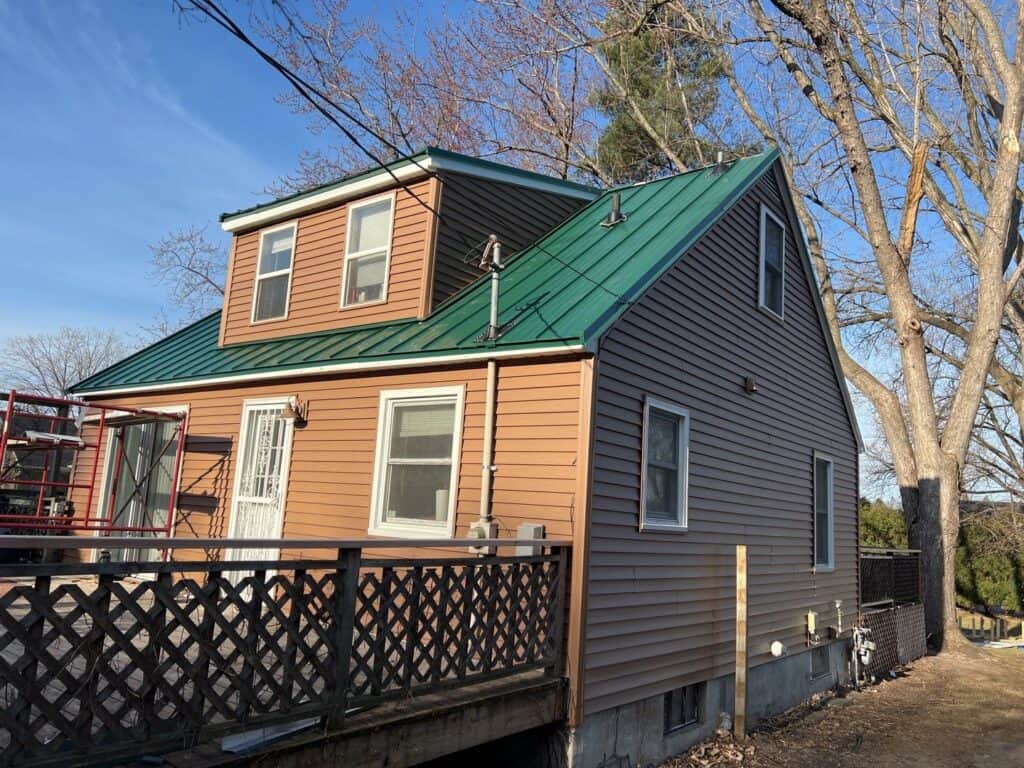
A standing seam metal roof in Minnesota runs $14 to $18 per square foot installed in 2026, tear-off, underlayment and labor included. On a typical 2,500 square foot Twin Cities roof, that works out to $35,000 to $45,000 for a roof that should outlast the next two asphalt replacements. Here is what drives the number, what the gauges and seam types mean for your home or building, and where the money actually goes.
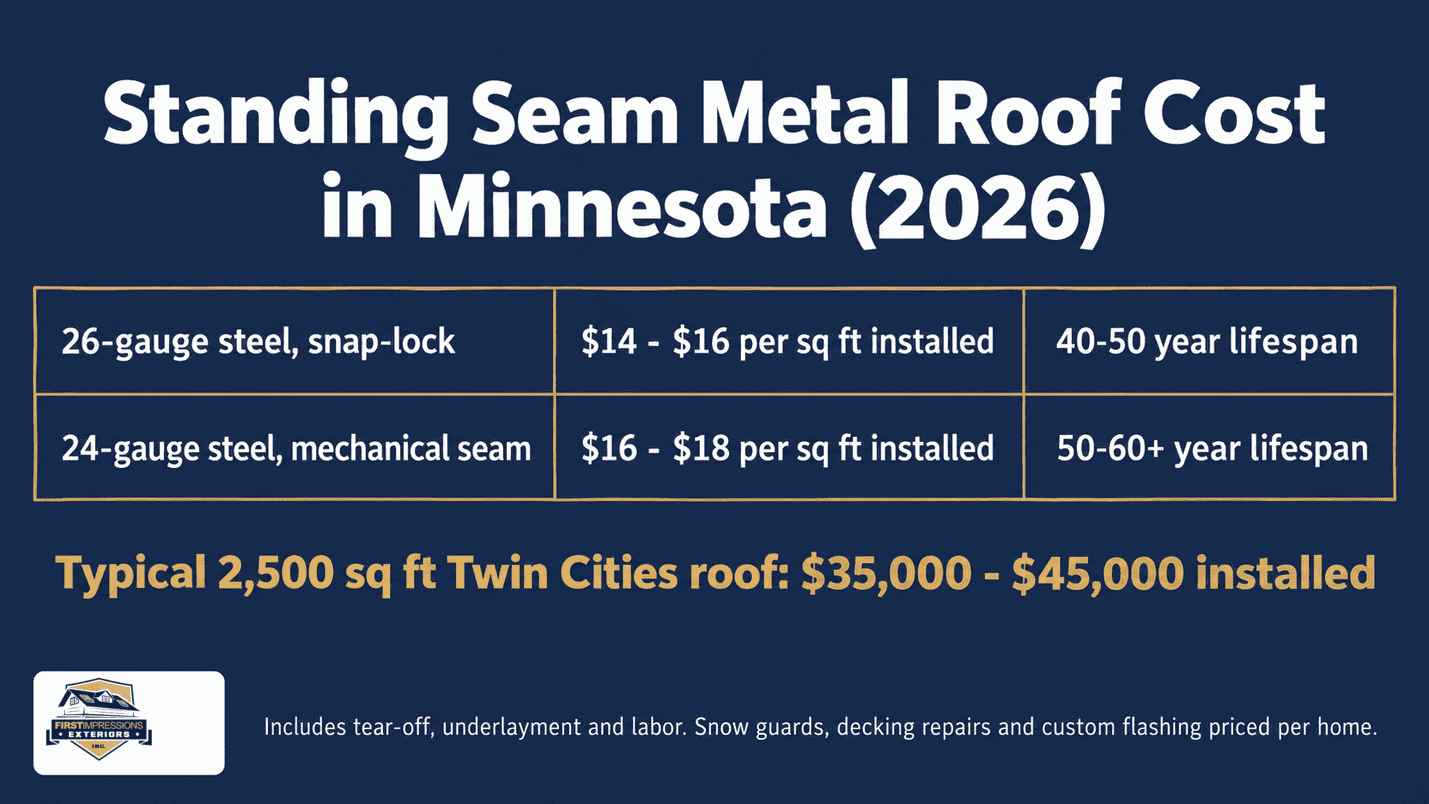
| System | Installed cost per sq ft | Expected lifespan |
|---|---|---|
| 26-gauge steel, snap-lock | $14 to $16 | 40 to 50 years |
| 24-gauge steel, mechanical seam | $16 to $18 | 50 to 60+ years |
Typical 2,500 sq ft Twin Cities roof: $35,000 to $45,000 installed.
Where the money goes
On most of the standing seam jobs we price, the total breaks down into four buckets. Roughly 40 percent is material: the steel coil, the panel fabrication, the clips and fasteners. Another 40 percent is labor. Standing seam takes two to three times the crew hours per square compared to asphalt, and it takes a crew trained on metal, not a shingle crew doing metal on the side. About 10 percent covers underlayment and code items, including the high-temperature underlayment metal requires and the ice and water shield Minnesota code calls for at eaves and valleys. The last 10 percent is trim and flashing: drip edge, eave and gable trim, valley work, ridge caps, and pipe boots, all in matching metal.
26-gauge snap-lock vs 24-gauge mechanical seam
We install both, and they are priced differently for a reason.
26-gauge snap-lock is the workhorse for most homes. Panels snap together over concealed clips, installation is faster, and on a standard pitched roof it performs for decades. It lands at the lower end of the range, $14 to $16 per square foot installed.
24-gauge mechanical seam uses a heavier steel panel and the seams are folded and locked together with a seaming machine. It handles lower slopes and harsher exposure, and it is what we recommend for most commercial work and lower-pitch residential sections. The heavier material and slower seam work put it at $16 to $18 per square foot installed.
Both are steel, both carry the Class 4 impact rating, and both use factory paint systems with finish warranties that run 30 years or longer. If a quote does not say which gauge and which seam type you are getting, ask.
What moves the price on a real quote
Roof size, pitch and layout
Metal is priced by the square foot of roof, not the square foot of house. A 1,600 square foot rambler can have 2,200 square feet of roof once you account for pitch and overhangs. Steeper pitches and cut-up layouts with dormers, valleys and skylights mean more trim, more flashing and more labor hours.
Tear-off and deck condition
Tearing off the old roof is part of every quote we write. What nobody can see until the old roof comes off is the deck. On older Twin Cities homes it is common to find a section of decking that needs replacing, and that usually lands between $1,000 and $4,000 depending on how much comes up. A good estimate sets the per-sheet repair rate before work starts so there are no surprises.
Underlayment
Metal runs hotter than asphalt, so the underlayment under it has to be a high-temperature product. Full-coverage high-temp underlayment costs more than standard felt, and it is not the place to save money.
Snow guards and snow management
Metal sheds snow. That is a benefit above a driveway and a problem above a front door. Anywhere snow could come down on an entry, walkway, deck or garage door, we plan snow guards or snow rails into the job. Budget roughly $1,500 to $4,000 depending on how much of the roof edge needs protection.
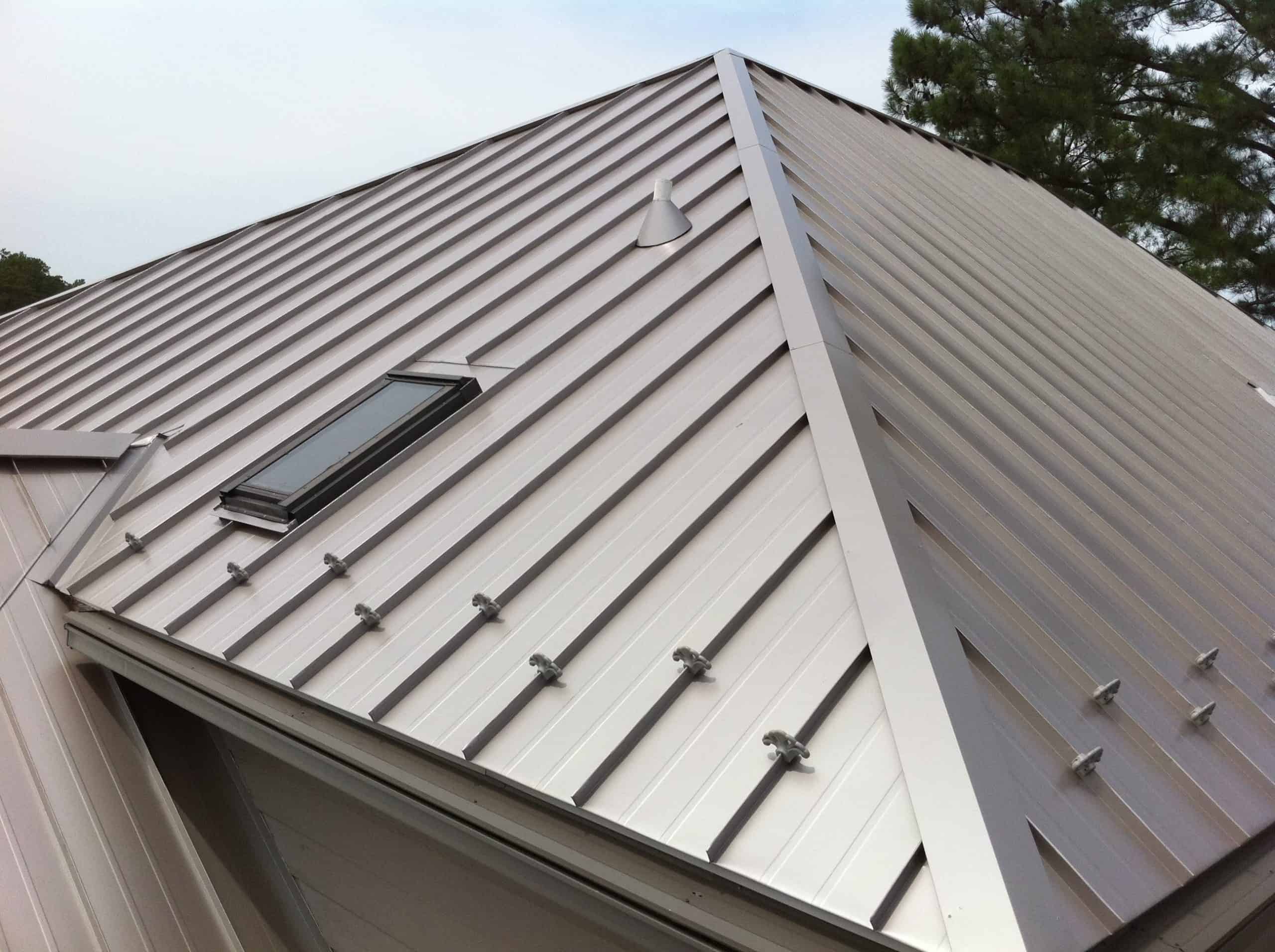
Snow guards on a completed standing seam installation. Small hardware, big difference over an entry.
Custom flashing and detail work
Chimneys, skylights, wall transitions and dead valleys all get custom-bent flashing in matching metal. This is the part of the job that keeps water out for 50 years, and it is priced per home.
Permits
Most Twin Cities cities charge a few hundred dollars for a reroof permit. Minneapolis scales its fee with the project cost, so a metal roof permit there runs higher than a shingle permit on the same house.
Standing seam vs asphalt over 50 years
The sticker gap closes when you look at service life. A premium architectural asphalt roof on that same 2,500 square foot Twin Cities roof runs $20,000 to $28,000 today and lasts 25 to 30 years in this climate. Over 50 years you will buy it twice, $40,000 to $56,000 before inflation pushes the second one higher, plus the tear-off hassle twice. A standing seam roof at $35,000 to $45,000 is bought once. The 50-year cost is comparable, and the metal roof is not the one getting replaced in year 26.
Built for Minnesota winters
Standing seam earns its keep here. Snow sheds off the panels instead of sitting and melting at the eaves, which takes most ice dam pressure off the roof. The interlocking seams have no exposed fasteners to back out over freeze-thaw cycles, and steel does not crack, curl or lose granules the way shingles do. Add the Class 4 impact rating and you have a roof built for hail season too, which matters if you have ever filed a hail damage claim on an asphalt roof.
Commercial standing seam
For commercial buildings, standing seam is one of the best long-term values on a sloped roof. Larger roof areas bring the per-foot cost toward the middle of the range, and 24-gauge mechanical seam is the standard spec because of panel length and foot traffic. We price commercial standing seam per building after a site visit, since parapets, rooftop units and drainage details change the scope more than square footage does. More on our commercial roofing work.
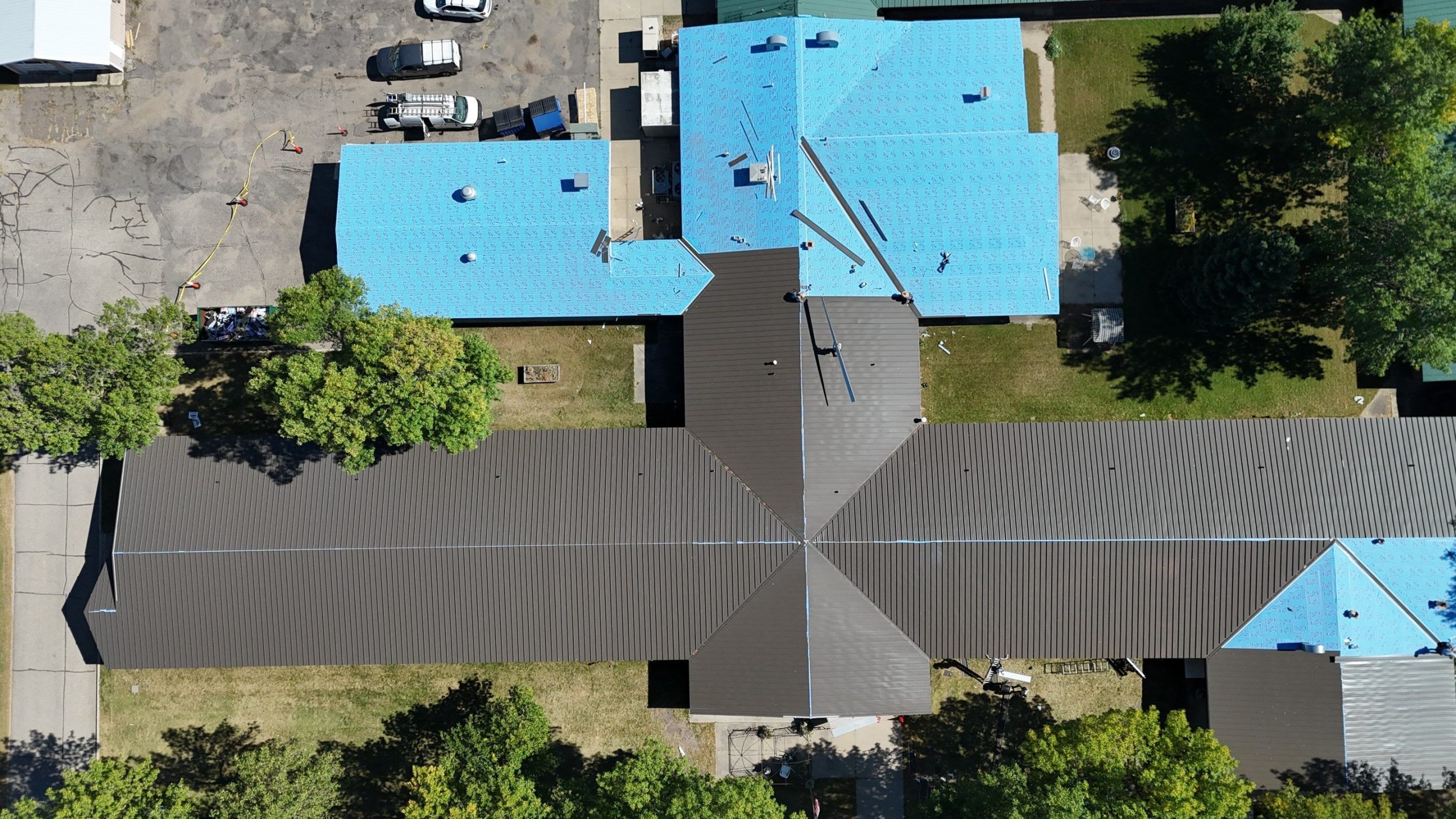
A commercial standing seam project mid-installation. New panels going down over high-temp underlayment.
Class 4 rating and insurance discounts
Steel standing seam panels carry a UL 2218 Class 4 impact rating, the highest impact resistance rating a roof covering can earn. Many insurance companies offer premium discounts for Class 4 roofs, commonly in the 10 to 30 percent range. We do not name carriers because every policy is different, but it is worth a call to your agent: on a typical Twin Cities premium, a discount like that returns real money every year the roof is on the house, and over a 50-year roof it adds up to thousands.
“First Impression Exteriors was great to work with!”
John K., Google review
Standing seam cost FAQs
In 2026, steel standing seam runs $14 to $18 per square foot installed in the Twin Cities, including tear-off, underlayment and labor. On a typical 2,500 square foot roof that is $35,000 to $45,000. Snow guards, deck repairs and custom flashing are priced per home.
Over 50 years, usually yes. Two premium asphalt replacements on the same roof run $40,000 to $56,000 in today’s dollars, while one standing seam roof at $35,000 to $45,000 outlasts both. If you plan to sell within 15 years, asphalt often makes more sense on resale economics.
Snap-lock panels click together over concealed clips and install faster, which is why they cost less. Mechanical seam panels are folded and locked with a seaming machine, handle lower slopes and harsher exposure, and use heavier 24-gauge steel. Both are concealed-fastener systems with no exposed screws.
Yes, anywhere shed snow could land on an entry, walkway, deck or garage door. Snow guards or rails typically add $1,500 to $4,000 depending on how much roof edge needs them. Away from those areas, snow shedding is one of the roof’s biggest winter benefits.
Often it can. Steel standing seam carries a UL 2218 Class 4 impact rating, and many insurers offer premium discounts for Class 4 roofs, commonly 10 to 30 percent. Every policy differs, so call your agent and ask what the discount is on your home.
Expect 40 to 50 years from 26-gauge snap-lock and 50 to 60 years or more from 24-gauge mechanical seam, with factory paint finish warranties running 30 years or longer. By comparison, a premium asphalt roof in this climate lasts 25 to 30 years.
Get a straight number for your roof
Every roof prices differently, and the only way to get your number is a real measurement. We will measure the roof, check the deck and ventilation, and write the estimate line by line so you can see exactly where the money goes, for a home or a commercial building. Schedule a free estimate or call us at (763) 762-8934.