In This Article
ToggleMinnesota Ice & Water Shield Requirements: What Building Code Requires (And Why Proper Installation Matters)
If you’re replacing your roof in Minnesota, one of the most important materials protecting your home is something you’ll likely never see again once the shingles are installed: ice & water shield.
Most homeowners don’t think to ask about it until after a leak occurs or an insurance adjuster mentions it during a claim. By then, it’s hidden beneath the shingles, making it impossible to verify whether it was installed correctly without removing the roof.
Because Minnesota experiences long winters, heavy snowfall, and frequent freeze-thaw cycles, our building code requires ice & water shield on asphalt shingle roofs. However, simply having “ice & water shield” listed on your estimate doesn’t necessarily mean it’s being installed where it should be, or in the amount your home actually needs.
At First Impressions Exteriors, we believe homeowners deserve to understand what ice & water shield does, what Minnesota building code requires, and why proper installation is just as important as the product itself.
At a Glance
Minnesota building code requires:
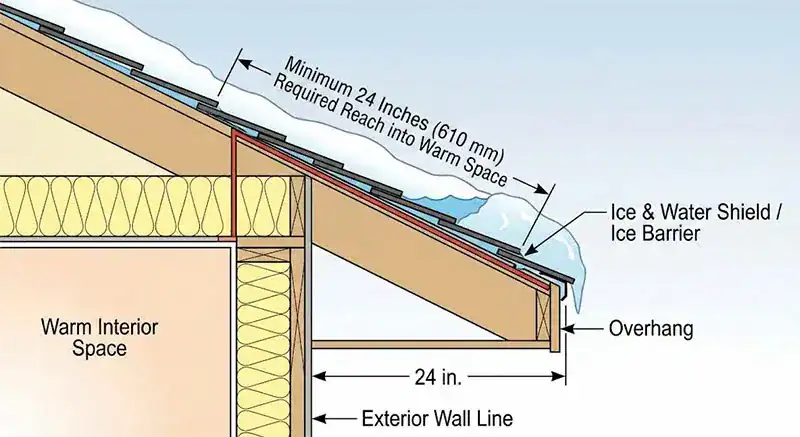
- Ice & water shield extending from the roof edge to at least 24 inches inside the exterior wall line.
- Additional protection may be required depending on roof design and manufacturer installation requirements.
Our standard installation includes:
- Minimum 6 feet of ice & water shield at all eaves
- Additional coverage where larger overhangs require it to extend beyond the interior warm wall
- Full-width ice & water shield in every valley from ridge to eave
- Protection around plumbing vents and roof penetrations
- Protection at roof-to-wall transitions
- Low-slope sections installed according to the roofing manufacturer’s requirements
Our philosophy is simple:
We install every roofing system the way we would want it installed on our own home.
What Is Ice & Water Shield?
Ice & water shield is a self-adhering waterproof roofing membrane installed directly on the roof decking before shingles are installed.
Unlike traditional felt or synthetic underlayment, it bonds directly to the roof deck and seals around roofing nails. This creates an additional layer of protection in areas that are most vulnerable to water intrusion.
It’s designed to help protect your home when water works its way beneath the shingles due to conditions such as:
- Ice dams
- Wind-driven rain
- Heavy snow
- Roof valleys that collect large amounts of water
- Roof penetrations such as plumbing vents
- Chimneys and roof-to-wall transitions
Think of it as an extra layer of insurance beneath your shingles, not your primary waterproofing system.
Your shingles remain your roof’s first line of defense.
What Does Minnesota Building Code Require?
Minnesota has adopted building code provisions requiring an ice barrier on asphalt shingle roofs because of our history of severe winter weather and ice dam formation.
In simple terms, the code requires ice & water shield to extend:
From the lowest edge of the roof to a point at least 24 inches inside the building’s exterior wall line.
Many homeowners assume this simply means installing six feet of membrane along the eaves.
Not necessarily.
The required amount depends on several factors including:
- Roof pitch
- Overhang depth
- Roof geometry
On many homes, six feet satisfies the requirement.
On homes with larger overhangs or steeper roof pitches, additional coverage may be required to ensure the membrane extends at least 24 inches inside the warm wall.
How First Impressions Exteriors Installs Ice & Water Shield
While Minnesota building code establishes the minimum requirements, we believe every roof should be evaluated individually.
Our goal isn’t simply to pass inspection.
Our goal is to install a roofing system that we would be confident putting on our own home.
Our standard installation includes:
1. Six Feet at Every Eave
Every asphalt roof replacement receives a minimum of six feet of ice & water shield along all eaves.
If the home’s design requires additional coverage to extend beyond the interior warm wall, we install more.
Rather than cutting the final course short to save material, we install the entire course.
For example, if calculations show that eight feet of coverage is required, we’ll install a full nine-foot third course rather than stopping partway across the roof.
It’s a cleaner installation and provides continuous protection.
2. Every Valley Receives Protection
Roof valleys handle more water than almost any other area of the roof.
They’re also where leaves, snow, and debris naturally collect.
That’s why we install one continuous course of ice & water shield in every valley from ridge to eave, regardless of whether it’s specifically required by code.
3. Around Roof Penetrations
Every plumbing vent, pipe penetration, and other vulnerable roof opening is protected with ice & water shield before flashing components are installed.
These areas experience constant expansion and contraction over the life of the roof and deserve additional protection.
4. Roof-to-Wall Transitions
Anywhere a roof meets a vertical wall creates another opportunity for water intrusion.
We install membrane in these transition areas before flashing is installed to provide redundant protection beneath the finished roofing system.
5. Low-Slope Roof Sections
Low-slope roof areas often require different installation methods than steeper roof sections.
Rather than applying the same approach to every roof, we follow the roofing manufacturer’s installation requirements.
Depending on the roofing system, that may include:
- Double synthetic underlayment
- Full ice & water shield coverage
- High-temperature membranes where required
Following the manufacturer’s specifications helps ensure the roofing system performs as intended and maintains warranty eligibility.
Why We Don't Automatically Recommend Full-Deck Ice & Water Shield
One of the biggest misconceptions we hear is that more ice & water shield is always better.
That’s simply not true.
Ice & water shield is designed for specific purposes and specific locations.
For most asphalt shingle roofs, we do not automatically recommend covering the entire roof deck with peel-and-stick membrane.
Why?
Because roof systems need to be able to manage moisture properly.
We reserve full-deck applications for situations where they’re required by the roofing manufacturer or where the home’s design justifies the additional protection.
For the vast majority of asphalt roofing systems, strategically placing ice & water shield in vulnerable areas provides outstanding protection while allowing the roof assembly to perform as intended.
A properly designed roofing system is about balance, not simply adding more material.
Choosing the Right Product
Not all ice & water shield products are the same, but proper installation is even more important than the brand name on the roll.
At First Impressions Exteriors, we most commonly install Resisto Ice & Water Shield because we’ve had excellent long-term performance with the product on Minnesota homes.
When installing roofing systems that require manufacturer-specific accessories to qualify for enhanced warranties, we’ll install the approved membrane from that roofing manufacturer.
For specialty applications requiring premium or high-temperature performance, such as certain metal roofing systems, we often specify Grace products because of their proven durability and performance.
No matter which product is used, our focus is on installing the right membrane in the right location and according to both building code and manufacturer specifications.
Why Proper Installation Matters More Than the Product Itself
A common mistake homeowners make is focusing only on whether their roofing estimate includes ice & water shield.
A better question is:
“How and where is it being installed?”
Two contractors may both list “ice & water shield” on their proposal, yet install dramatically different amounts and protect completely different areas of the roof.
The quality of the installation, not just the product, often determines how well your roof performs years down the road.
That’s why we encourage homeowners to ask questions before signing a contract.
A reputable roofing contractor should be able to clearly explain:
- How much ice & water shield will be installed
- Where it will be installed
- Why those areas are being protected
- Which product is being used
- Whether the installation meets both Minnesota building code and the roofing manufacturer’s requirements
If those questions can’t be answered clearly, that’s a conversation worth having before work begins.
Common Misconceptions About Ice & Water Shield
Over the years, we’ve heard many misconceptions about ice & water shield. Here are the ones we encounter most often.
Myth #1: Ice & Water Shield Makes Your Roof Leak-Proof
This is probably the biggest misconception.
Ice & water shield is not a guarantee that your roof can never leak.
Instead, it’s an additional layer of protection designed to reduce the chance of water entering your home if water gets beneath the shingles.
For example, during a severe ice dam, water can back up under the shingles and remain there for an extended period of time. Ice & water shield helps resist that water and seals around roofing nails, but no roofing system is designed to hold standing water indefinitely.
Proper flashing, attic ventilation, insulation, underlayment, and quality workmanship all play important roles in protecting your home.
Think of ice & water shield like a seatbelt.
It doesn’t prevent the accident, but it can significantly reduce the damage if one occurs.
Myth #2: More Ice & Water Shield Is Always Better
Not necessarily.
Ice & water shield is designed to solve specific problems in specific areas of a roof.
Those areas include:
- Roof eaves
- Valleys
- Roof-to-wall transitions
- Plumbing penetrations
- Chimneys
- Skylights
- Other vulnerable details
Installing membrane where it’s needed is far more important than simply covering more of the roof.
In fact, we generally do not recommend full-deck ice & water shield on standard asphalt shingle roofs unless it’s required by the roofing manufacturer or justified by the home’s design.
A properly designed roofing system should manage moisture effectively while allowing the roof assembly to perform as intended.
Myth #3: Ice & Water Shield Prevents Ice Dams
It doesn’t.
Ice & water shield does absolutely nothing to stop an ice dam from forming.
Ice dams occur when heat escapes from your home into the attic, warming the roof deck enough to melt snow.
That meltwater flows down the roof until it reaches the colder eaves, where it refreezes.
Over time, the ice builds up and traps additional water behind it.
The real solution isn’t more membrane.
The real solution is:
- Proper attic insulation
- Good air sealing
- Proper attic ventilation
- A correctly designed roofing system
Ice & water shield simply provides an additional layer of protection if an ice dam develops.
A Roof Is a System
One of the biggest mistakes homeowners make is evaluating a roof based on a single product.
A quality roofing system isn’t just shingles.
It’s a combination of components working together, including:
- Roof decking
- Ice & water shield
- Synthetic underlayment
- Starter shingles
- Flashing
- Ridge vent and ventilation
- Shingles
- Ridge cap shingles
Every component has a purpose.
When one part is installed incorrectly, it can affect the performance of the entire roofing system.
That’s why we don’t believe in selling upgrades just for the sake of selling upgrades.
Instead, we evaluate each roof individually and recommend solutions that make sense for that home’s design.
Does Insurance Pay for Additional Ice & Water Shield?
This is one of the most common questions we receive after storm damage.
The answer is:
Often, yes.
If additional ice & water shield is required to comply with current Minnesota building code, or is required by the roofing manufacturer’s installation instructions, it is commonly included as part of the insurance claim.
However, insurance estimates don’t always account for the actual amount of membrane required.
For example, an estimate may assume a standard amount of ice & water shield without considering:
- Larger roof overhangs
- Complex roof designs
- Multiple valleys
- Additional code-required coverage
When that happens, we carefully measure the roof and document the additional materials required.
If the estimate is missing code-required membrane, we submit documentation to the insurance company requesting a supplement.
Our goal isn’t to install more material than necessary.
Our goal is to make sure your roof receives the protection required by building code, manufacturer specifications, and your home’s unique design.
If you choose optional upgrades beyond those requirements, there may be additional costs depending on your insurance policy.
Why Roofing Estimates Can Vary So Much
Homeowners are often surprised when they receive roofing proposals that differ by several thousand dollars.
There are many reasons for this, but one of the easiest ways for a contractor to lower the price of a roof replacement is to reduce the amount of materials included in the estimate.
Since ice & water shield is hidden beneath the shingles once the roof is complete, it’s not something most homeowners ever see.
Some contractors install only the bare minimum.
Others may not fully account for larger overhangs, valleys, or roof transitions.
At First Impressions Exteriors, we don’t believe the hidden parts of a roof should be treated as an opportunity to cut costs.
We install roofing systems the way we would want them installed on our own homes.
That means following Minnesota building code, manufacturer installation requirements, and taking the time to protect the areas of your roof that are most vulnerable to water intrusion.
Questions Every Homeowner Should Ask Before Signing a Roofing Contract
Before hiring a roofing contractor, ask these questions:
- How much ice & water shield will be installed?
- Does that amount satisfy Minnesota building code for my home?
- Will valleys receive ice & water shield?
- Will roof-to-wall transitions be protected?
- Will plumbing vents and other penetrations receive additional protection?
- Which brand of membrane will be installed?
- Will the installation follow the roofing manufacturer’s specifications?
- If this is an insurance claim, have you verified the estimate includes all required ice & water shield?
A quality contractor should be happy to answer every one of these questions.
An informed homeowner is almost always a happier homeowner.
Minnesota Ice & Water Shield Requirements: Frequently Asked Questions
What does Minnesota building code require for ice & water shield?
Minnesota building code requires an ice barrier to extend from the roof’s edge to a point at least 24 inches inside the exterior wall line. Depending on your roof’s pitch and overhang depth, this may require more than the standard two courses (6 feet) of membrane.
Is six feet of ice & water shield always enough?
Not always.
Six feet is sufficient for many homes, but larger overhangs or steeper roof pitches may require additional coverage to comply with code. That’s why every roof should be measured individually rather than assuming the same amount works for every home.
At First Impressions Exteriors, we install a minimum of six feet at all eaves and add additional coverage whenever needed to extend beyond the interior warm wall.
Is ice & water shield required in roof valleys?
Minnesota building code doesn’t specifically require ice & water shield in every valley.
However, valleys collect more water, snow, and debris than almost any other area of the roof. Because of this, we install a continuous course of ice & water shield in every valley from ridge to eave as part of our standard installation.
Will ice & water shield stop ice dams?
No.
Ice & water shield helps protect your home if an ice dam forms, but it does not prevent ice dams.
Ice dams are typically caused by heat escaping into the attic due to inadequate insulation, air sealing, or ventilation. Addressing those underlying issues is the best way to reduce the likelihood of ice dams.
Can ice & water shield prevent roof leaks?
Ice & water shield is an additional layer of protection, not a guarantee against leaks.
When installed correctly, it helps reduce the chance of water intrusion caused by ice dams, wind-driven rain, and other challenging conditions. However, no roofing system is completely leak-proof, especially if water is allowed to pond on the roof for extended periods.
What brand of ice & water shield is best?
Several manufacturers produce excellent products.
At First Impressions Exteriors, we most commonly install Resisto Ice & Water Shield because we’ve had excellent long-term results with it on Minnesota homes.
When installing roofing systems that require manufacturer-specific accessories for enhanced warranties, we install the approved membrane from that roofing manufacturer. For specialty applications requiring premium or high-temperature performance, we often specify Grace products.
Ultimately, proper installation is more important than the logo printed on the roll.
Does homeowners insurance pay for additional ice & water shield?
In many cases, yes.
If additional ice & water shield is required by current building code or the roofing manufacturer’s installation instructions, it can often be included as part of your insurance claim.
Insurance estimates don’t always account for the actual amount of membrane your roof requires. We routinely review insurance estimates, measure the roof, and submit supplements when additional code-required materials have been overlooked.
Minnesota Building Code vs. First Impressions Exteriors Standard
| Feature | Minnesota Code Minimum | First Impressions Exteriors Standard |
|---|---|---|
| Eaves | Extend at least 24" inside the warm wall | Minimum 6' on every eave, with additional coverage as needed |
| Larger Overhangs | Additional coverage if required | Full additional courses installed, never cut short |
| Valleys | Not specifically required | Full-width ice & water shield from ridge to eave |
| Plumbing Vents | Follow manufacturer requirements | Protected on every roof |
| Roof-to-Wall Transitions | Varies | Protected as part of our standard installation |
| Low-Slope Sections | Follow manufacturer requirements | Installed according to manufacturer specifications using the appropriate underlayment system |
| Installation Philosophy | Meets minimum code | Installed the way we'd want it on our own home |
Our Philosophy
At First Impressions Exteriors, we don’t believe the best roofing systems are built by simply checking boxes on a building code checklist.
Minnesota building code establishes the minimum acceptable standard.
Our goal is to install roofing systems that provide lasting value, follow manufacturer requirements, and protect your home for decades.
Sometimes that means installing more ice & water shield.
Sometimes it means explaining why more isn’t actually better.
Every home is different, which is why we evaluate each roof individually instead of using the same approach on every project.
If we wouldn’t install it on our own home, we won’t recommend it for yours.
Schedule a Roof Inspection
Whether you’re replacing an aging roof, comparing estimates, or working through an insurance claim, understanding what’s included in your roofing proposal can help you make a more informed decision.
During every roof inspection, we’ll:
- Evaluate your existing roofing system
- Measure the roof to determine the proper amount of ice & water shield
- Review any insurance estimate for missing code-required materials
- Explain our recommendations and answer your questions
- Provide a detailed, transparent proposal so you know exactly what’s included
Our goal isn’t simply to sell you a new roof, it’s to help you understand how your roofing system works so you can make the best decision for your home.