In This Article
ToggleDoes Insurance Cover Roof Replacement in Minnesota?
Does insurance cover roof replacement in Minnesota? Short answer: yes, if your roof was damaged by a covered event such as hail, wind, or falling trees. Homeowners insurance generally does not cover roof replacement due to age, normal wear, poor maintenance, or installation defects. The amount insurance pays depends on your policy type, your deductible, and the extent of the damage.
Minnesota is one of the most hail-active states in the country, and roof claims are a routine part of homeownership here. Below is a complete look at how coverage works, what affects your payout, and what to expect from the process.
What Does Insurance Cover for Roof Replacement
Most Minnesota homeowner policies cover roof damage caused by:
- Hail impact
- High winds
- Falling tree limbs or debris
- Other sudden, accidental events recognized in your policy
What insurance typically does not cover:
- Normal wear and aging
- Lack of maintenance
- Damage that existed before the policy period
- Installation defects from a previous roofing job
- Cosmetic wear with no functional impact, depending on your carrier and policy language
The key distinction adjusters and contractors look for is whether the damage was caused by a specific, sudden event, or whether it reflects a roof simply reaching the end of its expected lifespan.
Will Insurance Replace the Entire Roof or Just Repair It?
A roof is not automatically replaced just because there is storm damage. Sometimes a targeted repair is the appropriate and sufficient fix. Full replacement typically becomes necessary when:
- Damage is spread across multiple slopes rather than isolated to one area
- The existing shingles are discontinued or no longer manufactured
- The shingles have become brittle with age, making a clean repair impossible without causing further damage
- Manufacturer installation requirements make a partial repair impractical
One question we hear often: if only one slope is damaged, does insurance have to replace the whole roof? Sometimes, yes. This typically comes down to whether a repair can reasonably match the rest of the roof in color, profile, and manufacturer. If the original shingle is discontinued or the available replacement would create a visible mismatch, that often supports a case for full replacement rather than a slope-by-slope repair. This depends on your specific carrier, policy language, and state requirements, so it is worth raising directly with your adjuster and contractor if your damage is limited to one area of the roof.
What We Look For During an Inspection
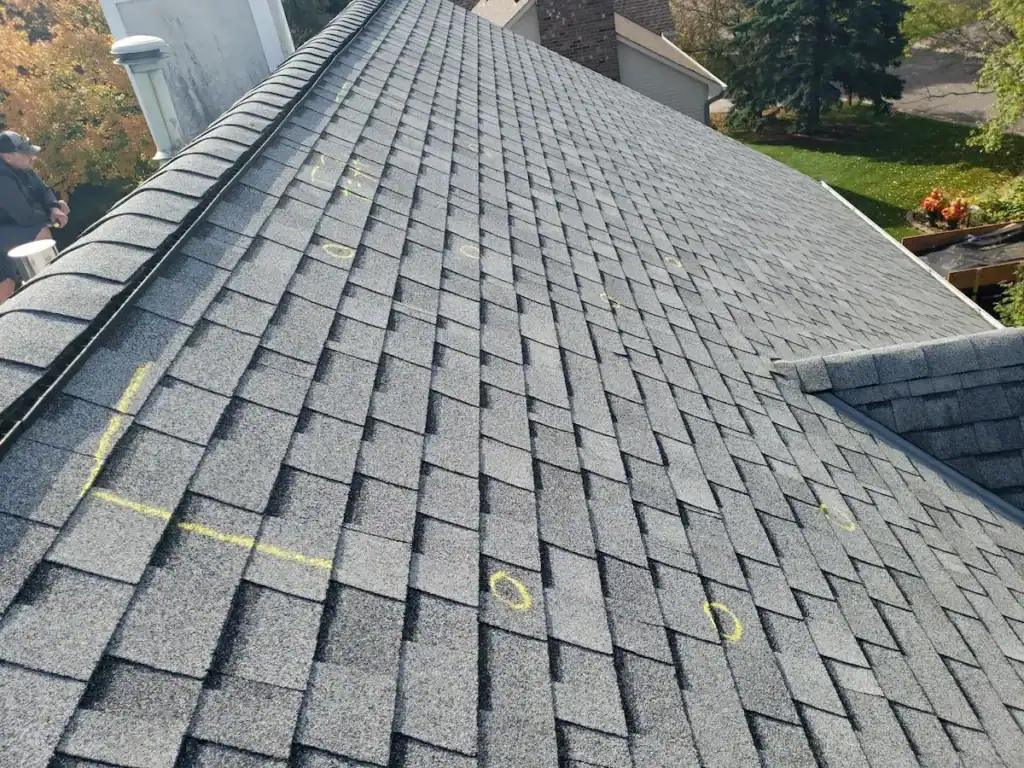
When we inspect a roof to determine whether storm damage is likely to qualify for a covered claim, we do not just look at the shingles. We start with the collateral damage around the property.
Soft metals such as roof vents, flashing, gutters, and downspouts tell the real story of a hailstorm. The size and severity of the dents and impact marks on these softer materials often reveal more about the actual force of the storm than the shingles themselves, since shingle damage can be harder to see from the ground.
We also look closely at oxidized surfaces for fresh spatter marks, which indicate a recent impact rather than long-term weathering. From there, we move to the shingles, checking for granule loss and bruising, which are the classic signs of hail impact on asphalt roofing.
We document this process thoroughly, including drone imagery of the full roof system, detailed photos of collateral damage, and manufacturer specifications when they are relevant to the claim. This layered approach helps build an accurate, complete picture of the damage before a claim is ever filed.
If your home has gone through several storms over multiple years, determining which event caused which damage can become more complicated. Thorough documentation helps establish the timing and extent of the damage and supports a more accurate claim.
RCV vs. ACV: Why Your Policy Type Changes Everything
One of the most important things to understand about your policy is whether it pays out on a Replacement Cost Value (RCV) basis or an Actual Cash Value (ACV) basis. This single detail can mean a difference of thousands of dollars in what you actually receive.
With a Replacement Cost Value policy, your insurance company pays the full cost to replace your roof with materials of like kind and quality, regardless of the roof’s age, minus your deductible.
With an Actual Cash Value policy, the payout factors in depreciation based on the age of your roof. For example, if your roof has an expected 30-year lifespan and it is 15 years old at the time of the claim, an ACV policy may only cover roughly half the cost of replacement. The homeowner is responsible for the remaining portion plus their deductible.
Here is what that can look like in practice on an $18,000 roof replacement:
- RCV policy, $2,500 deductible: insurance pays approximately $15,500, you pay $2,500
- ACV policy, roof at 50 percent depreciation: insurance pays approximately $6,500 to $9,000, you pay the remaining $9,000 to $11,500 plus your deductible
It is still a real benefit when legitimate storm damage occurs, even under an ACV policy, since the homeowner receives meaningful financial assistance toward the cost of the roof. But knowing which type of policy you have before you file a claim helps your expectations match the likely outcome.
Understanding Recoverable Depreciation
Many homeowners with an RCV policy are confused when their first insurance check is noticeably smaller than the total project cost. This is because most RCV policies pay in two parts.
The process typically works like this:
- The insurance company issues an initial check based on the Actual Cash Value of the roof, holding back the depreciation amount
- The roof replacement is completed
- The contractor provides a final invoice and certificate of completion
- The homeowner submits that documentation to the insurance company
- The insurance company releases the remaining recoverable depreciation
This is why a homeowner might receive an initial check for $8,700 on an $18,000 roof, with the remaining amount released only after the work is finished and documented. If you have an RCV policy, do not assume the first check is the final payout. Submit your completion documentation promptly to receive the remaining funds you are owed.
Do I Have to Pay My Insurance Deductible?
Yes. Every homeowner is responsible for their policy deductible on a covered claim, and this is true regardless of which contractor performs the work. A licensed, reputable contractor cannot legally waive or absorb your deductible for you.
Be cautious of any advertising that promises a “free roof” or offers to cover your deductible. This practice is not permitted and is a red flag that a contractor may be cutting corners elsewhere or inflating the estimate to offset the difference.
Code Requirements and Ordinance & Law Coverage
Minnesota’s building code requires certain materials and installation methods on every reroof, regardless of what was on the home previously. Ice and water barrier is a clear example. Minnesota Residential Code R905.1.2 explicitly requires an ice barrier membrane at the eaves of homes in our climate zone, extending at least 24 inches inside the exterior wall line. This is a code requirement on any reroof, not an optional upgrade, and it is typically included as its own line item on the insurance estimate.
Other items, such as proper attic ventilation, are addressed differently. Minnesota code requires that roofing materials be installed in accordance with the manufacturer’s installation instructions. If a shingle manufacturer requires specific ventilation as a condition of its warranty, that requirement becomes part of what code compliance demands on that particular installation. When this applies to your home, it is something we document and include as its own line item in the insurance estimate as well.
These code-required items are not extras we are trying to add to a project. They are requirements that apply to any licensed, code-compliant reroof in Minnesota, and a thorough contractor will identify them and include them in your insurance scope from the start.
Should You File a Claim or Pay Out of Pocket?
Not every instance of roof damage is worth filing a claim over. Filing generally makes sense when all of the following are true:
- The damage is from a covered event, almost always hail or wind in Minnesota
- The cost of repair or replacement is meaningfully higher than your deductible
- You have not filed multiple claims in the past several years
If the repair cost is close to your deductible, or if you have filed more than one claim recently, paying out of pocket may be the smarter financial decision. A trustworthy contractor should help you think through this decision honestly rather than push you toward filing regardless of the numbers.
You should also strongly consider an independent roof inspection before filing a claim, especially if you are not certain whether the damage is significant. An inspection from a contractor with no financial stake in pushing you toward a claim can help you make a clear-headed decision before you involve your insurance company.
How Long Does an Insurance Roof Claim Take?
While every claim is different, a typical Minnesota roof claim generally follows this path:
- Initial roof inspection
- Claim filed with your insurance carrier
- Adjuster inspection of the property
- Initial estimate received
- Supplement submitted, if additional damage is identified
- Supplement reviewed and approved
- Roof replacement scheduled and completed
- Final invoice and completion documentation submitted
- Recoverable depreciation released, if applicable
Straightforward claims with clear damage and a cooperative adjuster often move through this process in a matter of weeks. Claims that require additional supplements, occur during periods of high storm volume across the region, or involve a disputed scope can take longer.
What Happens After You File a Claim
Once a claim is filed, your insurance company assigns an adjuster to inspect the roof and determine the scope and value of the damage. This inspection results in an initial estimate of covered repairs.
Many insurance claims require one or more supplements after the initial inspection. Supplements are a normal part of the claims process when additional covered damage or required work is discovered, and this is common rather than unusual.
Adjusters handle a high volume of inspections, particularly after large regional storms, and it is common for some damage to be identified after the first inspection rather than during it. This is rarely intentional. It typically comes down to time constraints, claim volume following a major storm, or the difficulty of identifying every instance of damage during a single roof walk.
When we submit a supplement, we meet with adjusters on-site when appropriate and document everything as thoroughly as possible, including collateral damage, shingle condition, ventilation, flashing, and code-required items, not just the visible roof surface. The goal is to give the adjuster a clear, well-documented case so that approving the additional scope is straightforward.
If You Disagree With the Settlement
If you believe your insurance settlement does not reflect the true cost or scope of the damage, Minnesota law provides homeowners with a formal path to resolve the disagreement: the appraisal process.
Appraisal is a structured, non-judicial process built into most Minnesota property insurance policies. If you and your insurance company cannot agree on the amount of the loss, either party can invoke this process. Each side selects an independent appraiser, and if those two appraisers cannot agree, they select a neutral umpire to help reach a final, binding decision on the dollar amount of the claim.
This process resolves disagreements over the value of a loss without requiring a lawsuit. It is generally considered a last resort, used after a supplement has been submitted and a genuine disagreement remains about the amount owed.
Common Mistakes Homeowners Make
A few mistakes come up repeatedly during the claims process and can cost homeowners time, money, or coverage they were otherwise entitled to:
- Waiting too long after a storm to get an inspection
- Ignoring interior leaks or water stains rather than addressing them promptly
- Hiring an unlicensed or unverified contractor
- Signing contingency agreements without fully reading them
- Filing a claim for damage that is actually normal wear or maintenance related
- Not understanding their deductible before filing
- Removing or discarding damaged materials before they are documented
Avoiding these missteps starts with getting a thorough, honest inspection before you file anything.
Why This Matters for Minnesota Homeowners
Minnesota experiences frequent hail and wind events, and roof claims are a routine part of homeownership in this state. Understanding your policy type, knowing what adjusters and contractors look for during an inspection, and understanding that supplements are a normal part of the process can help you approach a claim with realistic expectations and a clear plan.
At First Impressions Exteriors, we work alongside homeowners on every storm-related project, from the initial inspection through documentation, adjuster meetings, and any necessary supplements. We document collateral damage, shingle condition, ventilation, flashing, and code-required upgrades using drone imagery, detailed photography, and manufacturer specifications, so the true scope of the damage is properly represented from the start.
Frequently Asked Questions About Insurance and Roof Replacement in Minnesota
Does insurance cover roof replacement after a hailstorm?
In most cases, yes. If the damage is caused by a covered event like hail or wind, your policy will typically cover repair or replacement, minus your deductible. Coverage details vary by policy, so it is worth reviewing your specific terms or asking your agent directly.
What is the difference between RCV and ACV for a roof claim?
Replacement Cost Value pays the full cost to replace your roof regardless of its age. Actual Cash Value factors in depreciation based on the age of the roof, which can significantly reduce the payout on an older roof.
How old can my roof be and still be covered?
Roof age does not typically prevent a claim from being covered if the damage is from a covered event, but it does affect how much you receive under an ACV policy due to depreciation. Carrier rules and underwriting guidelines also vary, so it is worth confirming directly with your insurance company.
Can my insurance company deny my roof claim?
Yes. Common reasons for denial include a lack of qualifying storm damage, damage attributed to wear and tear or lack of maintenance, an excluded peril under your specific policy, or other policy limitations. If you believe a denial was incorrect, you can request a reinspection or pursue the appraisal process.
Can I choose my own roofing contractor for an insurance claim?
Yes. Homeowners are free to choose any licensed contractor they want for an insurance-funded roof replacement. Your insurance company cannot require you to use a specific contractor.
Should I get my roof inspected before filing a claim?
Yes, this is generally a good idea, especially if you are unsure whether the damage is significant enough to justify a claim. An independent inspection helps you understand the actual condition of your roof before you involve your insurance company.
Does filing a roof claim automatically raise my insurance premium?
Not necessarily. Premium changes depend on many factors including your claims history, regional storm losses, underwriting guidelines, and your individual carrier’s policies. It is reasonable to ask your agent how a claim may affect your specific policy.
What is a supplement in an insurance claim?
A supplement is additional documentation submitted after the initial adjuster inspection to account for damage or required work that was not included in the original estimate. Many roofing claims involve at least one supplement as a normal part of the process.
What is the appraisal process and when is it used?
Appraisal is a formal, binding process under Minnesota law used to resolve disagreements over the dollar value of a covered loss. Each party selects an independent appraiser, and the two appraisers select a neutral umpire if needed to reach a final decision. It is generally used as a last resort after other attempts to resolve a disagreement have not worked.