
Water on the inside of a window does not automatically mean the window needs replacing. In a Plymouth winter, humid room air can condense on cold glass, even when a window is working as designed. Where the moisture appears matters: room-side glass, the outside surface, between sealed panes, or the surrounding wall. Each points to a different next step.
Start by finding the moisture, then check indoor humidity and the condition of the window. Replacing a window will not correct an unresolved indoor moisture problem.
What kind of window moisture are you seeing?
Room-side glass
Indoor air is reaching its dew point on cold glass. Check humidity, moisture sources and airflow.
Outside surface
Outdoor dew, often on cool mornings. Observe whether it clears as conditions change.
Between sealed panes
A possible insulated-glass seal failure. Have the glass assembly and window condition evaluated.
Trim, drywall or wall below
Condensation runoff or a separate water-entry problem. Investigate the source, especially after rain or thawing snow.
Wipe the accessible inside surface with a dry cloth. If the fog remains, do not assume it is between the panes until the outside surface has also been ruled out safely. There is no need to climb a ladder or take the window apart to make this first observation.
Why colder weather changes indoor humidity needs
Condensation forms when glass is cold enough for moisture in the surrounding air to collect on it. As outdoor temperatures fall, the inside surface of a window can get colder. The humidity setting that worked during a mild fall week may leave water or frost on the glass during a much colder spell.
Cooking, showering, laundry, humidifiers and other moisture sources add water vapor indoors. Closed shades and limited room-air circulation can leave the glass colder. A tighter home can also retain more moisture, which is why new windows do not eliminate the need for ventilation.
Indoor humidity chart for cold Plymouth weather
The Fenestration and Glazing Industry Alliance (FGIA) publishes the following recommended maximum indoor relative humidity values for condensation control with indoor air at 70°F. FGIA credits the Fahrenheit table to Home Energy Resource of Minnesota.
This is a window-condensation guide, not a universal comfort or medical recommendation. Your windows, indoor temperature and airflow affect when condensation starts. These limits do not guarantee dry glass in every home.
| Outdoor temperature | Recommended maximum indoor RH |
|---|---|
| 20°F to 40°F | 40% |
| 10°F to 20°F | 35% |
| 0°F to 10°F | 30% |
| -10°F to 0°F | 25% |
| -20°F to -10°F | 20% |
| Below -20°F | 15% |
Source: FGIA, “Understanding Indoor Condensation.” Temperature bands follow the source. At a shared boundary, use the colder-weather limit as the cautious starting point and watch the glass.
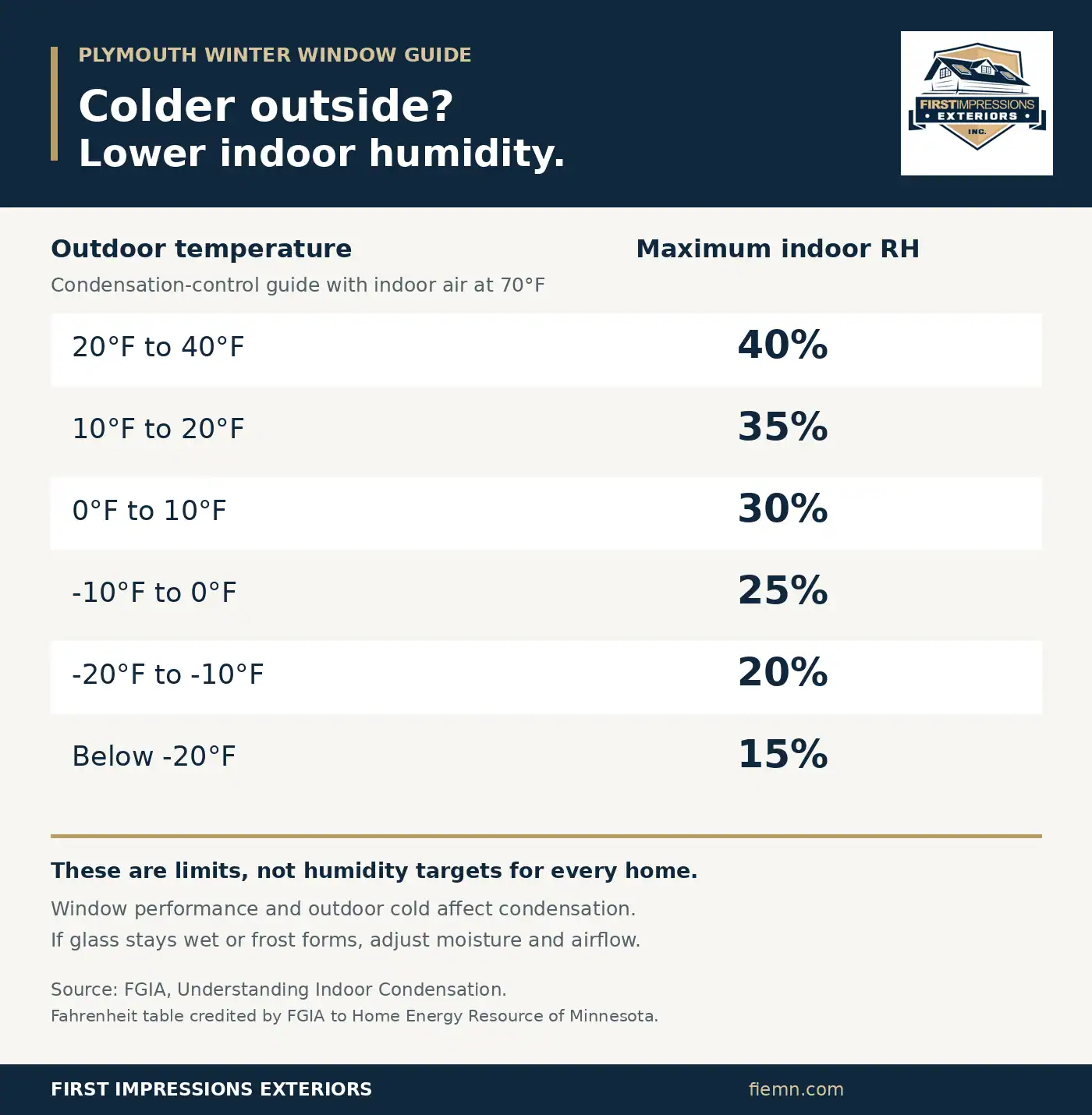
For example, 40% humidity is above the chart’s limit when it is 5°F outside: that temperature falls in the 30% band. Use a hygrometer or a thermostat with a humidity display rather than judging the air by how it feels. If lowering humidity leaves the home uncomfortable, or condensation continues, ask an HVAC professional to assess the ventilation and humidity controls.
University of Minnesota Extension also advises lower humidity during cold winter conditions and emphasizes finding the source of excess moisture. General year-round humidity advice and cold-weather condensation limits answer different questions. One fixed setting is not right for every season.
What to do when the inside glass gets wet
- Dry the glass and sill. Do not leave water sitting on wood, painted finishes or drywall.
- Measure humidity and review the humidifier setting. Compare the reading with outdoor conditions, then check whether the glass improves.
- Remove moisture at the source. Use bathroom and kitchen exhaust fans that vent outdoors. A recirculating range hood does not exhaust moisture outside.
- Let room air reach the windows. Open shades during the day and keep heating registers clear.
- Check the pattern. Record which rooms and windows are affected and whether moisture follows showers, cooking, severe cold, rain or snowmelt.
If a ventilation system is not working properly, have it checked by an HVAC professional.
When condensation points to a window problem
Moisture between sealed panes is different from moisture on the room-side glass. Persistent fog inside an insulated-glass unit can indicate a failed seal. Turning down the humidifier will not repair that seal. Depending on the product and the condition of the frame, a manufacturer or glass-service provider may offer a glass-unit or sash option. Other windows are better candidates for full replacement.
Look at the whole window: soft or rotted framing, damage around the opening, persistent drafts, and difficulty opening or closing deserve attention. Do not force a stuck window or cover a drainage opening with caulk. An inspection should identify whether the problem is the glass, hardware, installation, surrounding materials or a combination.
Wet drywall, stained trim or water that appears after rain or melting snow should not be dismissed as normal winter condensation. Those patterns need a separate water-entry check. Persistent standing water, deteriorating finishes or suspected mold also warrant prompt attention.
Will replacement windows stop condensation?
Better-insulating glass can keep the room-side surface warmer and reduce condensation risk. But no window can promise to stay dry under every combination of cold weather and indoor humidity. Replacement addresses a failing window; moisture control and ventilation address the air around it. Both may matter.
If your Plymouth home’s windows are damaged, drafty or no longer operating well, First Impressions Exteriors can assess window replacement options. See our Plymouth exterior services for local project help.
Window condensation questions
Does condensation mean I need new windows?
No. Moisture on the inside surface often calls for humidity and airflow checks first. Between-pane fog, deteriorated frames or operation problems need a window evaluation.
What indoor humidity should I use when it is 0°F outside?
The FGIA chart places 0°F at a shared boundary. Using the colder-weather band gives a maximum of 25% RH at 70°F indoors. Treat that as condensation-control guidance, not a guarantee or a personal health target.
Is condensation outside a window a problem?
Outdoor surface dew can occur when glass is cooler than the surrounding air’s dew point. It is different from trapped moisture between sealed panes and usually clears as outdoor conditions change.
Why do windows fog after replacement?
A tighter window can reduce air leakage that previously let indoor moisture escape. The home may need humidity or ventilation adjustments. Condensation alone does not prove the new window is defective.
Can I fix between-pane condensation with a dehumidifier?
No. Reducing room humidity does not restore the seal of an insulated-glass unit. Ask about product-specific service or replacement options.
Does First Impressions Exteriors repair window seals or replace glass only?
No. First Impressions Exteriors handles window replacements. For glass-only or seal-related service, contact the window manufacturer or a glass-service provider.
Research behind this guide
Technical guidance was checked against FGIA’s “Understanding Indoor Condensation,” University of Minnesota Extension’s “Controlling moisture problems in your home,” the U.S. Department of Energy Building America Solution Center’s “Managing Indoor Humidity and Ventilation in Cold Weather,” and Andersen’s condensation and window-service guidance.
Reviewed for this guide: October 2026. First Impressions Exteriors · Minnesota contractor license BC631617.